今天没吃药 感觉自己萌萌哒~~
新概念·1册·笔记6(Lesson101~120)
Lesson101~102
1.card卡片、明信片
a business card名片
a credit card信用卡
a bank card银行卡
2.介词短语后置,作定语(描述名词)
a card from Jimmy吉米的明信片
a car in the garage在车库里的车
the kid between us我俩中间那孩子
the tree in front of the building楼前那棵树
the car on the way路上那辆车
3.特殊疑问词+else(复习)
What else.?
Where else.?
Which else.?
Whose else.?
Who/Whom else.?(whom是宾格)
What else does he say?他还问了什么?
Where else have you been?你还去了哪儿?
Which else do you like?你还喜欢哪一个?
Whose else do you choose?你还选了什么?
Whom else do you describe?你还描述了谁?
4.动词v.+up表示程度
speak up,大声地说,清楚地说。(=louder please)
up作副词用时可表示强度等的由弱到强、由低到高
5.直接引语和间接引语
(1)是什么
直接引语:直接引用说话人原来所说的话(直接引语放在引号里)
间接引语:原话的转述(把原话变成宾语从句)
(2)直接/间接引语,相互转换的变化
A.人称:人称变了,谓语动词的三单也变(驻足的角度/人变了)
B.指示代词:this-that、these-those
C.时间状语(驻足的时间点变了)
now现在 - then那时候、
today今天 - that day那天、
yesterday昨天 - the day before那天的前一天、
tomorrow明天 - the next day那天的后一天
D.地点状语(不知道,等我找点例子)
例子:
She says, “I will leave this evening.
She say(that) she will leave that evening.
He says,”My sister was here yesterday“.
He says that his sister was there the day before.
He says to me, “I’ve found my wallet.
He tells me(that) he has found his wallet.
She says, “You can sit here, Jim.
She tells Jim(that) he can.sit.there.
He says:‘I hope you are all well. ’ 他说:”我希望你们都身体健康。”
He says he hopes we/they are all well. 他说他希望我们/他们都身体健康。
(人称I变he,谓语动词hope变hopes,人称you变we/they)
The girl says: ‘I have finished my homework.’ 那个姑娘说:”我已完成了家庭作业。”
The girl says that she has finished her homework. 那个姑娘说她已完成了家庭作业。
(人称I变she,谓语动词have变has,人称my变her)
(3)间接引语的主从时态不同(与下面宾语从句联动,但这个是单独的,不能合并)
主句用一般现在时,间接引语可以用任意时态
She says she’s got a headache. 她说她头痛。(主一般现在,从一般现在)
He says he’s staying at a Youth Hostel. 你说他正住在一家青年招待所(主,从现在进行)
He says he has sold his house. 他说他已卖掉了房子。(主一般现在,从现在完成)
He says(that)his sister was there the day before(主一般现在,从一般过去)
6.附加疑问句(反义疑问句)
(1)提问
A.构成:陈述句+简短的一般疑问句(找动词,再否定)
B.反意: 前肯后否,前否后肯(相反)
C.前后谓语的时态、人称,单复数一致
(2)步骤:动、反、换
be动词
Lily is in Tokyo, isn’t she?莉莉在东京,不是吗?
It’s a nice day, isn’t it?这是个好天气,不是吗?
It’s not a nice day, is it?这不是个好天气,是吗?
Chinese people were hard years ago, weren’t they?
do动词(实意动词)
He doesn’t say very much,does he?他没说很多,是吗?
Lily goes to school on foot,doesn’t she?莉莉走去学校了,不是吗?
Sam had a meeting last night, didn’t he?sam昨晚有个会议,不是吗?
情态动词
Lily can’t speak French, can she?莉莉不会说法语,是吗?
Sam must stay at the hotel,mustn’t he?山姆必须留在旅馆里,不是吗?
have动词
You have finished your work, haven’t you?你已经完成了你的功能做,不是吗?
sam hasn’t had his lunch, has he?山姆没吃午饭,是吗?
(3)反义疑问句的功能
期待对方支持、赞同观点
It’s pretty, isn’t it?这很漂亮,不是吗?(想让你说对)
=It’s pretty, right eh?(可用right eh?来替代后半句。)
(3)怎么回答
回答这种问句时要简略,要根据事实回答。(客观事实,而非主观认同)
如果答语本身是肯定的,就用 Yes.
如果答语本身是否定的,就用 No.
7.宾语从句
(1)概念(句子作宾语)
I love(主谓)you(宾)
I think(主谓)I love you(宾语从句)
(2)时态要求(主句一般现在,从句任意时态)
I think(that) he is awful(从一般现在)
He says(that)he loved her.(从一般过去)
He knows(that) she has gone(从现在完成)
He is sorry (that) he will leave.(从一般将来)
(3)语用功能
a.表达观点:I think that(宾语从句)
b.引述话语:上面的间接引语
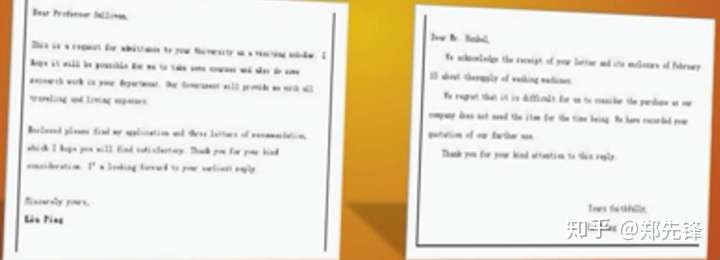
8.书信格式
(1)称呼:Dear…,
(2)书写格式(两种)
a.顶格写,一段后空一行。(正式场合,雅思之类的,看起来比较清晰)
b.每段前面,空4格,不用空行。(给亲戚朋友写,家书之类的,不用太拘束)
(3)落款
位置(都在左边、or都在右边)
Yours,
zxf
Your sincerely,
zxf
(4)常用开头语
写信:I’m writing to tell you that……..我写信想告诉你……..
回信1:I am very glad to hear from you.很高兴收到你的来信。
回信2:I’m sorry it has taken me a long time to reply to you.很抱歉这么久才给你回信。
(5)常用结束语
写信:I’m looking forward to your reply.期待你回信。
通用1:I hope you are all well.希望你一切顺利。
通用2:Best wishes to you.送上我最美好的祝福
9.课后练习
A
1 She says she has shut the door.她说她已经关门了
2 He says he has put on his coat.他说他已经穿外套了
3 He says he has read this magazine.他说他已经读杂志了
4 They say they have spoken to the boss.他们说他们已经跟老板谈话了。
5 They say the sun has risen.他们说太阳已经升起来了
B
1 He says he has got a cold.他说他已经感冒了
2 He says he feels cold.他说他觉得冷
3 He says he will sell his house.他说他要卖房子
4 He says he needs an X-ray.他说他需要照个X光
5 He says he must wait for a bus.他说他必须等公交车
6 He says he has got an earache.他说他耳朵已经痛了
7 He says he feels thirsty.他说他觉得口渴
8 He says he needs a haircut.他说他需要剪头发了
9 He says he feels ill.他说他觉得不舒服

Lesson103~104
1.exam考试、test测试的区别
exam,考试(examination的简写,比较重要的考试)
test,水平测试(就只是试一试你能考多少分,不是很重大的考试)
2.too与enough
(1)enough的用法
A.形容词adj.+enough
He failed the exam because it wasn’t easy enough. 他不及格,因为题不够容易。
(不是enough easy)
It is cold enough.天够冷的
B.enough+名词n.
He didn’t buy the car because he didn’t have enough money.
他没买那部车,因为他没有足够的钱。
I have enough time to read.我有足够的时间来读书
C.可以用在 enough… for sb./sth.和 enough… to do sth.结构之中:
She hasn’t got enough money for a holiday. 她没有足够的钱去度假。
This dress isn’t big enough for her. 这件衣服对她来说不够大。
She’s not old enough to live alone. 她还没长大到能独自生活的地步。
(2)too的用法(有否定含义)
A.too表示“过于”
I can’t go out. It’s too hot. 我无法外出,太热了。
She couldn’t answer the questions because they were too difficult for her.
她无法回答问题,因为这些问题对她来说太难了。
The apple is too sweet.这苹果太甜了!
The boy is too handsome.这男孩太帅了!
You are too late.你太晚了!
B.可以用在 too…for sb./sth.结构之中:
This skirt is too big for me. 这条裙子对我来说太大了。
It’s too easy for me. 这对我来说太容易了。
C.可以用在 too+adj./adv.+to do sth.结构之中:太…以至于不能…
The exam was too difficult for him to pass. 考试太难了,以至于他无法通过。
The box is too heavy for you to carry. 这个盒子太沉了,你没法扛起。
She is too young to live alone. 她年纪太小了,无法独自生活。
It’s too far to walk home from here. 从这儿步行回家太远了。
The baby is too young to eat by himself.这婴儿太小了,以至于不能自己进食
It is too cold for me to go out.今天太冷我没法出去。
He walks too slowly to get there on time.他走得太慢,不能按时到达那儿。
He is too busy to see me.他太忙根本没时间见我
The hat is too large to wear.这帽子太大,没法戴。
Never too old to learn.一个人绝对不会太老,以至于不能学习(活到老学到老)
Life is too short to waste.生命太短了,以至于不能浪费(生命短暂,经不起浪费)
(3)比较too和enough的不同
The wall is too high for them to climb over. 这堵墙太高了,以至于他们无法攀越过去。
The wall is low enough for them to climb over.这堵墙太矮了,以至于他们可以攀越过去。
3.短语:数字+of the sb./sth.(一个群体其中的N个东西)
sixteen questions:16个问题
sixteen of the questions:那些问题其中的16个问题
two teachers:两位老师
two of the teachers:那些老师其中的两位老师
4.句型:sb. didn’t (某人没做什么)
对某实意动词的否定,只能用助动词。
He didn’t write a word.他一个字都没写。
He didn’t say a word.他一句话都没说。
He didn’t make any money他一分钱都没挣。
5.课后练习
A
1 I couldn’ t speak to the boss. He was too busy.我没办法跟我老板说话,他太忙了
2 I couldn’t go out. It was too cold for me to go out.我不能出去,天气对我来说太冷了
3 I could answer all the questions. They were very easy.我能回答所有问题,太简单了。
4 Is that suitcase light enough for you to carry?这手提箱你搬起来轻不轻?
5 Is your brother old enough to be a member of our association?你哥大到加入社团吗?
6 They couldn’ t see that film. They were too young.他们不能看电影,年龄太小了
B
1 Yes, he could. It was cheap enough for him to buy.对他来说太便宜了
2 No, he couldn’t. It was too expensive for him to buy.对他太贵了。
3 Yes, they could. They were fresh enough for them to eat.他们吃起来够新鲜
4 No, they couldn’t. They were too stale for them to eat.他们吃起来太不新鲜了
5 Yes, they could. It was loud enough for them to hear.听起来对他们够大声
6 No, they couldn’ t. It was too low for them to hear.听起来对他们太小声了
7 Yes, he could. It was low enough for him to climb.够低了对他爬过去
8 No, he couldn’t. It was too high for him to climb.太高了对他爬山
9 Yes, she could. It was soft enough for her to eat.对他吃起来足够舒服了。
10 No, she couldn’t. It was too hard for her to eat.太难了对他下口。
11 Yes, she could. It was sweet enough for her to eat.她吃起来够甜了
12 No, she couldn’t. It was too sour for her to eat.让她吃,太酸了
6.形容词1:聪明
(1)clever:adj·聪明的(含贬义)
身体的灵巧、思维敏捷、足智多谋、较快地理解掌握所学知识技能
(2)smart(社会意义上的聪明)
思维能力强,办事巧妙,圆滑处理人际关系
(3)intelligent:聪明的,有智慧的
(4)brilliant:adj.极端聪明的
(5)talented:有才能的、有天赋的
7.形容词2:笨
(1)stupid:adj笨的(脑子有问题,无法修复的)
缺乏理智,先天迟钝、智力低下
(2)silly(脑子没问题,可以教好)
缺乏常识、判断力,作出令人可笑的行为和举止
Lesson105~106
1.动词不定式
不定式构成:to+动词原形(也就是前面说的,双动词同时出现,必须弱化其中一个)
(1)不定式作宾语(动词+to+v.动词原形)
He wants(主谓)to buy a car(宾:不定式)他想买辆车。
He hopes(主谓)to pass the French exam(宾:不定式)他希望自己能通过法语考试
I want(主谓)to leave(宾:不定式)我想离开。
(2)不定式作宾语补足语:动词+名词/宾格代词(某人sb.)+to+动词原形
I want you(主谓宾)to carry it(宾语补足语)我想让你扛着它。
He wants them(主谓宾)to listen to it(宾语补足语)他想让他们听那个。
I want you to try it.我想让你试一试
I want him to move his car.我想让他移一下他的车。
Tell him(谓宾)to move it(宾语补足语)让他搬它。
Tell him to go back right now.告诉他快点回来。
(3)不定式的否定:not to(在to前面否定就行)
He decided(主谓)not to buy the house(宾)他决定不买这幢房子。
He told me not to close the window. 他让我不要把窗户关了。
Tell him not to move it. 告诉他不要搬动它。
Tell him not to give present.跟他说不要送礼物了。
例外的固定搭配:don’t want sb. to do不想某人干什么事
want只能这样去否定,not不加在to前面
I don’t want him to worry about me.我不想让他担心。
2.携带的几种用法(复习)
(1)carry:携带、运送
A taxi carried them to the station yesterday.昨天,的士带着他们去了站台
(2)bring:带来
May I bring my boyfriend here next time, mom?下次我能带我男朋友来吗
The day before yesterday, he brought us some good news.前天他带了些好消息给我们
(3)take:带走
Please take the umbrella with you.It’s going to rain.请你带伞,快下雨了。
(4)fetch:去了再回来,取
The boss says to her,”please fetch me my documents in that room”
老板告诉她,“请去我的房间,取我的文件,然后给我”
3.课后练习
A
1 I want you to spell it.我想你去拼写他
2 I want you to telephone him.我要你打电话给他
3 I want you to wear it.我要你穿上它
4 I want you to ask her.我要你去问他
5 I want you to tell them.我要你去告诉他
6 I want you to help us.我要你来帮我们
B(What do you want me to do?)
I want you to carry it.我要你去搬它
I want you to correct it.我要你去改正它
I want you to listen to it.我要你去听它
I want you to describe it.我要你描述它
I want you to move it.我要你去移动它
I want you to try it.我要你去尝试它
I want you to finish it.我要你去完成它
I want you to keep it.我要你去保持它
C
1 She is telling him not to hurt himself. She doesn’t want him to hurt himself.
她告诉他不要伤害他自己。她不会要他伤害自己的。
2 She is telling him not to slip. She doesn’t want him to slip.
她告诉他不要滑倒。她不会要他滑倒的。
3 She is telling him not to fall. She doesn’ t want him to fall.
她告诉他不要掉下去的。她不会要他掉下去的。
4 She is telling them not to miss it. She doesn’t want them to miss it.
她告诉他们不要错过它。她不会要他错过它的。
5 She is telling him not to break it. She doesn’ t want him to break it.
她告诉他不要打破它。她不会要他打破它的。
6 He is telling her not to drive it. He doesn’t want her to drive it.
他告诉她不要开它。他不会要她开它的。
D
1 Because she doesn’t want him to hurt himself.因为她不会要他去伤害自己
2 Because she doesn’t want him to slip.因为她不会要他滑倒
3 Because she doesn’t want him to fall.因为她不会要他掉下去
4 Because she doesn’t want them to miss it.因为她不会要他们错过它
5 Because she doesn’t want him to break it.因为她不会要他打破它
6 Because he doesn’t want her to drive it.因为他不会要她开它
4.常见口语简略(仅限于口语,非书面)
(1)want to= wanna
I want to have a big house in Beijing
I wanna have a big house in Beijing
(2)thanks=thx
(3)kind of= kinda
(4)going to= gonna
5.常用简短口语
(1)got it明白没?
(2)You wish!想的美!
(3)So what?那又怎么样呢?
(4)No way没门!
(5)No offence.没有冒犯的意思。
(不要在谈判中,随便用sorry,不然他会觉得你认错了。)
(6)Eyes front朝前看。
(7)Good point说的好!
(8)All right.没关系。
Lesson107~108
1.也的用法(复习+新学)
also:肯定句,实义前情系后,比较正式
too:肯定句、疑问句句末,比较口语
as well:不用于否定句,句末(可以被too取代)
either:否定句,句末(唯一的否定句专用)
例句:
He doesn’t like coffee either.他也不喜欢咖啡。(否定专用)
他还懂西班牙语。
He knows Spanish as well.
He knows Spanish too.
He also knows Spanish.
这个商店也卖婴儿食品。
The shop sells food for babies as well.
The shop sells food for babies too.
The shop also sells food for babies.
恐怕这绿裙子对我来说也太小了。
I’m afraid this green dress is too small for me as well
I’m afraid this green dress is too small for me too.
I’m afraid this green dress is also too small for me.
2.would
(1)句型
would like to+v.….想要去干某事
would like+sth.…想要某物
want+n.(想要)
want to+v(想要做)
(2)陈述句
I would like a new pair of shoes.我想要一双新鞋
I would like to buy a new pair of shoes我想要去买一双新鞋。
(3)疑问句(表达委婉的请求)
Would you like…?你愿意……吗?
Would you like to go with us? 你乐意与我们一起去吗?
Would you like to go to my party?你可以来参加我的晚会?
Yes. I’d love to
Would you like some tea or coffee?您是要点茶还是咖啡?
I’d like tea please.
**3.Could you+v. …?您能……吗?**(表达委婉的请求,同would,可互相替换)
比 Can you…?更婉转(翻译作:您)
Could you tell me the way to the post office?您能告诉我去邮局的路吗?
Could you lend me some money?您能借我点钱吗?
Could you give me a hand?您能帮我一把吗?
4.形容词的比较级和最高级(第二册才学副词的比较级)
(1)比较级/最高级的变化规则(这是单音节词的,多音节词在111-112课)
A.大多数是加上-er和-est:
small—-smaller—-smallest
new—-newer—-newest
old—-older—-oldest
B.以-e结尾,直接加r和st
large—-larger—-largest
nice—-nicer—-nicest
late—-later—-latest
C.辅+元+辅(汉堡堡结构)双写最后一个辅音字母加er,est
big—-bigger—-biggest
thin—-thinner—-thinnest
fat—-fatter—-fattest
D.辅音字母加y结尾,变y为i,加er,est
happy—-happier—-happiest
easy—-easier—-easiest
heavy—-heavier—-heaviest
E.少数形容词不规则变化(单独记忆)
good—-better—-best
bad—-worse—-worst
F.大多数较长的形容词(两个音节以上)
more比较级,most最高级
(2)比较级的句型结构(只用于两者之间)
A.主语+谓语(系)+比较级+than
He is cooler than before.他比以前帅。
She is smarter than before.她比从前时尚。
He was faster than any other one.他比其他人都快。
B.主语+谓语(系)+比较级(如果所指很清楚,那么可独立存在)
This coat is longer. 这件外衣较长。(一般比较的是手臂长度,十分清楚,不用说出来)
(3)最高级的句型结构(用于3者或3者以上)
主语+谓语(系)+the+最高级+范围
It is the biggest rabbit in the world.这是全世界最大的一只兔子。
He is the shortest man in the world.他是全世界最矮的人。
It is the busiest day in this month.今天是这个月最忙的一天。
That girl is the tallest student in our class. 那位姑娘是班上个子最高的学生。
He is the tallest of us all.他是我们当中个子最高的
Hans is the tallest student in our class.汉斯是我们班里最高的学生
The day before yesterday was the hottest day in a year.前天是一年里面最热的一天
(4)常用的范围
A.短语
全世界:in the world
全中国:in China
全北京:in Beijing
一年中:in a year
一季度中:in a season
一个月中:in a month
全班:in the(our) class
我们所有人中:of us all
B.从句做范围(I have ever …我所….的)
I have ever seen.我所见过的
I have ever been.我所去过的
I have ever bought.我所买过的
例句:It is the largest crowd I have ever seen.这是我见过最大的人群。
5.俗语,可用于作文,比较级和最高级的(可以背下来)
(1)East, west, home is best.金窝银窝,不如自己的草窝。
(2)Facts speak louder than words.事实胜于雄辩。
(3)Health is better than wealth.健康高于财富。
(4)The sauce is better than the fish.喧宾夺主。
(5)To make the best even better.没有最好只有更好。
6.课后练习
A
1 It is cool today, but it was cooler yesterday.今天冷,但昨天更冷
2 It is wet today, but it was wetter yesterday.今天潮湿,但昨天更潮湿
3 He’s late again today, but he was later yesterday.他今天又晚到,但昨天更晚到
4 This test is easy, but that one is easier.这测试很容易,但那个测试更容易
5 This bookcase is large, but that one is larger.这个书柜很大,但那个更大
B
1 I am older than you are.我比你大
I am the oldest in the class.我是班里最老的
2 I am taller than you are.我比你高
I am the tallest in the class.我是班里最高的
3 I am lazier than you are.我比你懒惰
I am the laziest in the class.我是班里最懒的
4 I am heavier than you are.我比你重
I am the heaviest in the class.我是班里最重的
5 I am luckier than you are.我比你幸运
I am the luckiest in the class.我是班里最幸运的
6 I am fatter than you are.我比你胖
I am the fattest in the class.我是班里最胖的
7 I am thinner than you are.我比你苗条
I am the thinnest in the class.我是班里最苗条的
8 I am bigger than you are.我比你大只
I am the biggest in the class.我是班里最大只的
C
1 But that street is cleaner.但那街道很干净
It is the cleanest street I have ever seen.这是我见过的最干净的街道
2 But that man is older.但那个男人年龄大
He is the oldest man I have ever seen.他是我见过的最老的人
3 But that river is longer.但那条河很长
It is the longest river I have ever seen.这是我见过的最长的河
4 But that woman is shorter.但那女人很矮
She is the shortest woman I have ever seen.她是我见过的最矮的女人
5 But that knife is blunter.但那把刀很钝
It is the bluntest knife I have ever seen.这是我见过的最钝的刀
6 But that car is cheaper.但那辆车很便宜
It is the cheapest car I have ever seen.这是我见过的最便宜的汽车
Lesson109~110
1.提建议的方式
(1)方式列举
Shall I …?
Would you like to …?
May I have …?
Can I …?
Could you …?
Why don’t you+v.…?
Why not+v.…?
How about…?
What about…?
I was wondering if you would like to …我一直在想你是否愿意去…(过去进行时)
You should do…(上级对下级,口气很一般)
You’d better…(上级对下级,口气很一般)
(2)例句:
我能跟你吃顿饭吗?
Shall I have dinner with you?
Would you like to have dinner with me?
May I have dinner with you?
Can I have dinner with you?
Could you please have dinner with me?
其他:
This books is a bit difficult.Why not read something easier?
这本书有点难,为什么不读点容易的?
What shall we do this Sunday?周日我们应该做什么?
Why don’t we go to the Science Museum?为什么我们不去科学博物馆?
Where would you like to visit?你想要去哪儿逛逛?
I’d like to visit the Great Wall.我想去长城
2.复数的判定:只要比1大(1.0000001也是复数)
比1大的东西,即使比2小,也需用复数表示
一勺半(两种)
One and a half teaspoonfuls
half a teaspoonful
半小时:half an hour
一个半小时:(两种)
one and a half hours
an hour and a half
半天:half a day
一天半:(两种)
one and a half days
a day and a half
**3.instead adv.**(一般不直接翻译)
(1)替代,adv.
I’m tired and can’t attend the meeting,you could go instead.我累到不能开会,你代我去
She did not want to go to the university. Instead, she decided to become a singer.
她不想上大学,而是决定成为一名歌手。
Don’t marry her Marry me instead.不要和她结婚,和我结婚吧。
Shall we watch a movie instead?咱能不能改看电影?
Shall we use white instead?可以改用白色吗?
(2)代替,而不是(instead of+n./pron.):
She wanted to have milk instead of juice.她想要牛奶,而不是果汁。
She prefers buying books instead of borrowing them from the library.
她宁可买书而不愿到图书馆去借。
ops! I put in sugar instead of salt.啊!我错把糖当盐放了。
I gave him advice instead of money.我给了他忠告,而不是钱
I took your bag instead of mine.我错拿了你的手提包。
4.课文:v.+比较级
Eat more and smoke less.吃多点少抽烟。
Drink more and eat less.多喝水少吃东西。
Play more and study less.多玩少学习。
5.“少”的总结
(1)不可数名词
little 几乎没有
a little 有一点
比较级less—-最高级least
(2)可数名词
few 几乎没有
a few 有几个
比较级fewer—-最高级fewest
(3)例句
There is little milk in the cup.杯子几乎没有牛奶了(不可数)
He knows only few words of French.他几乎不懂几个法语单词。(可数)
There are a few good man now.这年头好人不多了(可数)
He has few friends here, he feels lonely.他这里没朋友,感觉寂寞(可数)
You look sad,Kate.你看起来不好
Yeah, I have made a few mistakes in my paper.是啊,我试卷错了几道题。
The twins have never learned French, so they can speak only little French.
双胞胎绝对不会学法语,所以他们几乎不能说法语
He makes less money than before.他赚的比以前少了。
a little money/ water/coffee一点儿钱/水/咖啡(都不可数)
Just a little,please.请稍加一点儿。(不可数)
I’ve got fewer than you have.我们拥有的比你的少。(可数)
I’ve got very few.我有为数很少的几块。(可数)
I’ve got less than you have.我所拥有的比你所拥有的少。(不可数)
I’ve got very little.我所有的为数很少。(不可数)
6.“多”的总结
(1)可数/不可数
many很多+可数名词
much很多+不可数名词
比较级more—-最高级most(可数不可数都一样)
(2)例句
He makes more money than before.他赚的比从前更多了。
You’ve got more biscuits than I have.你的饼干比我的多。
You’re got more chocolate than I have.你的巧克力比我的多。
7.越来越…:比较级+and+比较级
warmer and warmer越来越暖和
busier and busier越来越忙
taller and taller越来越高
more beautiful and more beautiful
=more and more beautiful 越来越漂亮
less and less expensive 越来越便宜
The doctor tells Mary to eat more vegetables and less meat,
because she is getting fatter and fatter.越来越胖
(隐含了跟以前作比较,但没有写出,还是要用比较级)
I have less money than you, but I have more friends than you.
我的钱比你少,但我朋友比你多。
If there are less traffic on the streets, fewer deaths will be caused.
如果路上的交通越少,死亡数也会越少。
8.不规则形容词的比较级和最高级(总结)
好:good/well—-better—-best
坏:bad—-worse—-worst
多:many/much—-more—-most
少:little—-less—-least(不可数)
few—-fewer—-fewest(可数)
远:far—-farther—-farthest
—-further—-furthest
例句:
I haven’t got many either.我也没有很多。(可数)
I’ve got less than you have.我有的比你少。(不可数)
I haven’t got much either.我也没有很多(不可数)
I’ve got fewer than you have.我有的比你少。(可数)
9.课后练习
B
1 I haven’t got much jam. I’ve got very little.(不可数)
2 I haven’t got many potatoes. I’ve got very few.(可数)
3 I haven’t got many oranges. I’ve got very few.(可数)
4 I haven’t got many vegetables. I’ve got very few.(可数)
5 I haven’t got much meat. I’ve got very little.(不可数)
6 I haven’t got much money. I’ve got very little.(不可数)
C
1 I’ve got more soap than you have.
2 I’ve got more fruit than you have.
3 I’ve got more books than you have.
4 I’ve got more presents than you have.
5 I’ve got more eggs than you have.
6 I’ve got more stationery than you have.
D
1 I’ve got less jam than you have. I’ve got the least.(不可数)
2 I’ve got fewer potatoes than you have. I’ve got the fewest.(可数)
3 I’ve got fewer vegetables than you have. I’ve got the fewest.(可数)
4 I’ve got fewer oranges than you have. I’ve got the fewest.(可数)
5 I’ve got less meat than you have. I’ve got the least.(不可数)
6 I’ve got less money than you have. I’ve got the least.(不可数)
Lesson111-112
1.多音节形容词的比较级
(1)比较级的中高低:(多音节都是+原级)
较高比较级(more expensive比较贵,the most expensive最贵)
较低比较级(less expensive比较不贵, the least expensive最不贵)
平级比较级(as expensive as一样贵):be as+形容词/副词的原级+as
平级比较的否定:not as … as:不及
(2)平级例子(肯定的,正面的)
as hot as:一样热
as pretty as:一样漂亮
as cool as:一样的帅气
as happy as:一样的开心
as interesting as:一样的有趣
It is as hot as it was yesterday.天气和昨天一样热
Lily is as pretty as Sara.莉莉和沙拉一样漂亮
Mr. Wu is as cool as Mr Wang.他俩一样的帅气
This watch is as expensive as the car.这块手表和那辆车一样贵。
This book is as interesting as the movie.这本书和那部电影一样有趣。
The green apple is as sweet as the red one.这个绿苹果同那个红苹果一样甜。
The policeman is as tall as the policewoman.这个男警察与那个女警察个子一样高。
The white knife is as sharp as the black one.这把白色的小刀与那把黑色的小刀一样锋利。
I don’t know as many people as you do.我认识的人没有你认识的多。
Robert is not as old as he looks.罗伯特没有他看上去那么高。
The blue car is not as clean as the red car.蓝车没有红车干净。
This apple is as sweet as that one
(3)平级的否定(not as+形/副+as)不及
A is not as cool as b:A不及B帅气
A is not as happy as B:A不及B开心
A is not as interesting as B:A不及B有趣
She is not as fat as she was before.她不像以前那样胖。
She is not as young as before.她不像从前那么年轻。
My car is not as expensive as your car.我的车不及你的贵
This car is not as clean as that one.这车没那辆干净。
(4)比较级/最高级例子(多音节)
This coat is the least expensive one in the shop.
This coat is the cheapest one in the shop.这件外套是店里最不贵的。
She is more beautiful than before.她比从前更漂亮。
His hairdo is more fashionable than before.他的发型比从前时尚。
The office buildings in HK are the most expensive.香港的写字楼是最贵的。
(5)形容词无比较,比较级,最高级的区别
This test is difficult
This test is more difficult
This is the most difficult test have ever done.
This book is interesting.
This book is more interesting.
This is the most interesting book I have ever read.
2.课后练习***
A
1 This book is cheap, but that one is cheaper.
2 This book is expensive, but that one is more expensive.
3 This question is easy, but that one is easier.
4 This question is difficult, but that one is more difficult.
B
1 Is the policeman as tall as the policewoman?
No, he isn’t. The policeman isn’t as tall as the policewoman.
2 Is the man as short as the woman?
No, he isn’t. The man isn’t as short as the woman.
3 Is the boy as old as the girl?
No, he isn’t. The boy isn’t as old as the girl.
4 Is the red pencil as blunt as the green pencil?
No, it isn’ t. The red pencil isn’t as blunt as the green pencil.
5 Is the blue car as clean as the red car?
No, it isn’t. The blue car isn’t as clean as the red car.
6 Is the woman as fat as the man?
No, she isn’t. The woman isn’t as fat as the man.
C
1 No, it isn’t . It is more expensive.
It’s the most expensive radio I’ve ever seen.
2 No, he isn’t. He is more intelligent.
He’s the most intelligent person I’ve ever met.
3 No, it isn’t. It is more interesting.
It’s the most interesting book I’ve ever read.
4 No, it isn’t. It is less difficult.
It’s the least difficult test I’ve ever done.
Lesson113-114
1. 钱的表达
note:纸币
coin:硬币
(1)英镑单位pound也可以复数
a fifty-pound note(有横杠)
a fifty pounds note(无横杠+s)
(2)量词单位note更可以复数
two fifty-pound notes(有横杠)
two fifty pounds notes(无横杠+s)
(3)英镑单位cent可以复数
a fifty-cent coin(有横杠)
a fifty cents coin(无横杠+s)
(4)量词单位cent更可以复数
three fifty-cent coins(有横杠)
three fifty cents coins(无横杠+s)
2.none/some of的使用
(1)构成
some of+n.复数名词/不可数名词(一些…)
none of+n.复数名词/不可数名词(没有…)
(2)例句
Here are some of your favorite books.这是一些你最喜欢的书。(books复数)
None of the money is mine.这些钱中没有一文是我的。(money不可数)
None of the students knows of the exam.学生们谁都不知道考试的事(students复数)
(none,没有人,做主语,是三单形式)
I thought there would be many students in the hall,but when I got in, I found none.
none= none of the students(是前面提到的人,可能会有老师在)
no one,一个人也没有
None of our passengers can change this note.我们乘客中没有一个能换这钞票的(复数)
None of the students学生中没有人
None of us我们当中没有人
None of them他们当中没有人
(2)none单独使用/no的比较
There’s no beer in the refrigerator.冰箱里没有啤酒。
There’s none.没有什么东西。
I bought no magazines.我没买什么杂志。
I bought none.我没买什么东西
*3.例外beside/except的区别(一个加,一个减)*不怎么懂,以后再加强
except:prep.除…之外(在群体里)
beside:prep.与…相比(不在群体里)
No one wears glasses besides you.与你相比,他们都没人戴眼镜(不在群体里)
They all went to sleep except me.除我之外,他们都去睡觉了(在群体里)
4.so与neither引导的简短回答(为了语言简短,缩略前句说过的词)
(1)构成:So/Neither +助动词+主语。
肯定:so
否定:neither
原则:前后的时态和人称一致
(2)so的例句
I like Lee Hong
I like Lee Hong, too. == So do l.(like动词,用助动词do)
I hate money.
I hate money, too.== So do l.(hate动词,用助动词do)
She hates money, too=So does she.(三单用does)
I can do it
I can do it, too==So can I.(情态动词优先,用can)
He can do it, too. =So can he.(情态动词没有变化)
They were young.
I was young, too. =So was l.(助动词可以直接用,过去时用was)
She was young, too. =So was she.(过去时+三单用was)
I’m hungry.我饿了。So am I.我也一样。
I want some coffee.我想要些咖啡。So do I.我也一样
I was at the party last night.我昨晚参加聚会了。So was I.我也一样。
I can swim very well.我游泳游得好So can I.我也如此。
I saw George last night.我昨晚看见乔治了。So did I.我也一样。
I’ve got a cold.我感冒了。So have I.我也一样。
(3)neither的例句
I didn’t go to school last week
I didn’t go to school, either. =Neither did I.(助动词可以直接用,过去时用was)
She didn’ t go to school either. =Neither did she
I am not a nurse.
I am not a nurse, either.=Neither am l.(助动词可以直接用,过去时用was)
She is not a nurse, either.= Neither is she
I haven’t had breakfast.
I haven’t had breakfast, either.= Neither have I.(助动词可以直接用,过去时用was)
He hasn’t had breakfast, either.= Neither has he
I’m not tired.我不累。
Neither am I.我也一样。
I don’t want any tea.我不想要任何茶。
Neither do I.我也一样。
I wasn’t tired this morning.我今天不累。
Neither was I.我也如此。
I can’t speak Chinese.我不会讲汉语。
Neither can I.我也如此
I didn’t buy a new car last year.我去年没买新车。
Neither did I.我也如此。
I haven’t got a headache.我没头疼。
Neither have I.我也一样
I will never come to this restaurant again.The food is terrible.
Neither will I.
If you don’t go to the park tomorrow,Neither will I.(将来)
5.课后练习
A否定
1 There are no books on that shelf.
2 I have got no money.
3 There is no coffee in this tin.
4 I saw no cars in the street.
B.否定+any
1 No, I haven’t got any milk.
I’ve got no milk. I’ve got none.
2 No, I haven’t got any envelopes.
I’ve got no envelopes. I’ve got none.
3 No, I haven’t got any magazines.
I’ve got no magazines. I’ve got none.
4 No, I haven’t got any bread.
I’ve got no bread. I’ve got none.
C.neither+否定句
1 Neither am I. I’m not hungry, either.
2 Neither did I. I didn’t meet him, either.
3 Neither was I. I wasn’t at church yesterday, either.
4 Neither do I. I don’t like ice cream, either.
5 Neither can I. I can’t swim, either.
6 Neither am I. I’m not a doctor, either.
D.so倒装
1 So am I. I’ m hungry, too.
2 So did I. I met him, too.
3 So was I. I was at church yesterday, too.
4 So do I. like ice cream, too.
5 So can I. I can swim, too.
6 So am I. I’m a doctor, too.
6.乘坐飞机用语
the international flight 国际航班
the domestic flight 国内航班
the business class 商务客舱
the economy tourist class 经济舱
the flight number 航班号
the airfight ticket 机票
a boarding check 登机牌
the connecting flight 转机
the non-stop flight 直飞
the checked baggage 托运的行李
the carry-on baggage 随身行李
the baggage claim area 行李领取处
baggage tag 行李牌
luggage cart 行李推车
luggage:外出旅行时所带的物品
baggage:行李的通称。
May I have a pillow blanket?请给我拿一个枕头&毯子。
Can you put your seat upright?您可以把座位升直吗?
May I reline my seat?我可以放下我的座椅吗?
Lesson115-116
1.前缀im-
特征:一般加在p或者m开头的形容词前面,表否定意义
impossible:adj不可能的
impolite:不礼貌的
imperfect:不完美的
immature:不成熟的
immoral:没有道德的
2.固定搭配:have something to+动词(倒装的感觉,之后有更多的课程说这个)
have something to drink:喝点东西
have something to eat:吃点东西
have something to buy:买点东西
have something to read:读点东西
3.固定搭配:剩下的什么都没有了
none left
nothing left
nobody left
4.不定代词
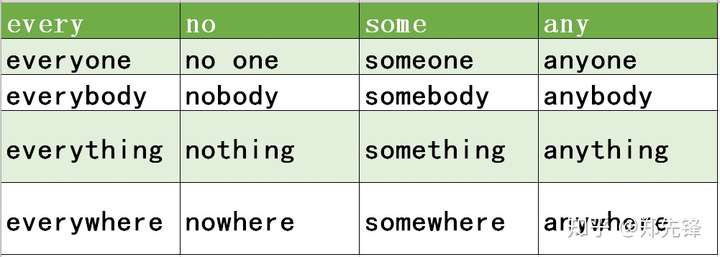
(1)everyone/everybody/everything/everywhere:强调整体
everyone/everybody:大家
everything:一切
everywhere:到处
Hi, everyone.大家好!(整体里面的每个人)
Everything is quiet.一切都很安静。
A humorous person is accepted everywhere.幽默的人到处都受欢迎。
(2)no one/nobody/nothing/nowhere:否定
no one/nobody:没有人
nothing:什么都没有
nowhere:没有一个地方
There is no one at home.家里一个人都没有。
I have nothing to do.我没事可做。
She has nowhere to go.她无处可去。
(3)some只用在肯定句
some+复数:一些
some+单数:某一
someone/somebody:某人
something:某事
somewhere:某地
There is someone at home.家里有人。
I have something to do.我有事要做
She went somewhere.她去了什么地方。
(4)any否定、疑问句
any+复数:一些
any+单数:任一
anyone anybody:任何人
anything:任何事
anywhere:任何地方
Is there anyone at home?有任何人在家里吗?
I don’ t have anything to do.我没事可做。
She didn’t go anywhere.她哪都没去。
(5)any&no的转化
nothing= not anything
I did nothing yesterday. =I didn t do anything
nobody= not anybody
I met nobody. =I didnt meet anybody
nowhere= not anywhere
I went nowhere. =I didnt go anywhere.
I went nowhere.(=I didn’t go anywhere.)我哪儿也没去。
I saw no one.(=I didn’t see anyone.)我谁也没看到。
(5)不定代词可作主语、宾语和表语。
A.作主语
#不定代词作主语时,都看作单数,用单数谓语动词(三单)
Everyone is asleep.大家都睡了。
Everything is untidy.一切都乱糟糟的。
Nobody has told me about it.没有人告诉过我有关这件事的情况。
Everybody knows it.大家都知道这事。
Everything is fine.一切都都顺利。
Someone is asking to see you.有人要求见你。
B.作宾语:
I’ve got nothing to wear.我没有穿的衣服了。
I’ve heard nothing.我没听到什么动静。
I saw no one.我谁也没有看到。
I don’t know anyone here.这儿我谁也不认识。
C.作表语:(主系表)
There’s nothing on the shelf.架子上什么也没有。
There’s somebody in the garden.花园里有个人。
That’s nothing.那没什么。
Is there anyone there?那有人吗?
There’s something under that chair!那个椅子下有个什么东西!
Is there anything on this shelf?这个架子上有什么东西吗?
(6)例句
Everything has its beauty, but not everyone sees it.万物皆美,只是缺少发现美得眼睛。
She wants her son to become somebody.她希望自己的儿子会成为个人物。
Nothing could ever stand between you and the free land.
没有什么能够阻挡我对自由的向往。
5.课后练习
A不定代词
1.I did nothing.
2.I saw no one.
3.I went nowhere.
4.I met nobody.
B否定+不定代词
1.No, I didn’t hear anything. I saw nothing.
2.No, I didn’t speak to anyone. I spoke to no one.
3.No, I didn’t go anywhere. I went nowhere.
4.No, I didn’t buy anything. I bought nothing.
5.NO, I didn’t write to anybody. I wrote to nobody.
6.No, I didn’t meet anyone. I met no one.
C.不定代词做主语
1.Everyone’s looking out of the window.
2.Everyone’s hurrying to work.
3.Everyone’s eating.
4.Everyone’s drinking lemonade.
D.********
1.No, I haven’t got anything to eat. 我没有任何东西吃。
I’ve got nothing to eat.我什么都没吃
He’s got something to eat.他有东西可以吃
2.No, I haven’t got anything to do.
I’ve got nothing to do.
They’ve got something to do.
3.No, I haven’t got anything to drink.
I’ve got nothing to drink.
She’s got something to drink.
4.No, I haven’t got anything to read.
I’ve got nothing to read.
He’s got something to read.
Lesson117-118
1.同位语
A.功能:解释名词
B.结构:名词+名字,名字+名词
例句:
While, our little boy, Tommy found two small coins…我们的小男孩,tommy
China,an ancient country in Asia中国
Jeremy Shu-How Lin,a popular basketball player from Taiwan.林书豪
Fengtai District,a well-known district in Beijing.丰台
Shi Hengxia, a confident”s” wom 芙蓉姐姐
My favorite star, Wuzun, is very cool
My hometown, Shan’an, is a beautiful place
Yesterday I met Mary, my old friend
Hello, I’m Venus Im a teacher.
+I’m from Shan’xi province.
+I live in Beijing now.
=Hello. I’m Venus, an English teacher in New Oriental.
I’m from Shan’xi province, a nice place in the west of China.
I live in Beijing, the capital city of China.
Sara is my friend
+She is a doctor
=Sara, my friend is a doctor.
2.both:两个都
(1)both:代词
Both are good.(both= the two books)两本书都很棒
He put both into his mouth.他把两个都放进嘴里了。
(2)both:副词(动词前、情be后)
We both tried to get the coins, but…..(both做同位语,修饰we)
We both like English(both做同位语,修饰we)
They can both sing.(both做同位语,修饰they)
3.过去进行时
(1)功能:过去某一时刻、时段正在进行的情况或动作
(2)结构:主语+ was/were+ doing现在分词
She was doing her homework at 10:00 last night.
They were having a date from 7:00-9:00 yesterday.
(3)疑问形式:was/were提前
She was doing her homework at 10:00 last night
Was she doing her…?
(4)否定形式was/were+ not
They were having a date from 7:00-9:00 yesterday
They were not having a date….
(5)过去进行时和现在进行时的对比
(等我翻翻前面的再来)
4.时间状语从句(1)
(1)概念:句子作时间状语
He was calling his girlfriend at 10:00.
He was calling his girlfriend when he was driving.
(2)引导词:when\ while\ as\ before\ after
when:万能引导词
whie:多接进行时态
as:“一边…一边…”,紧接着发生
例句:
When you think you know nothing,you begin to know something
While everyone was working hard,I was enjoying my holiday
We always sing as we walk.
Jane was waiting for me when I arrived.
My brother came into the living room while I was dancing.
What_was Jim writing when the teacher came in?
When I arrived at his office, he was speaking on the phone.
I was cooking a meal when you rang me.
While she was watching TV, she heard a sound outside the room.
When I was doing the housework, my husband telephoned me from the office.
当我正在干家务时,我丈夫从办公室打电话给我。
While I was listening to the stereo, my mother came into the room.
我正在听立体声节目时,我母亲进房间了。
Just as she was cleaning her shoes, George knocked at the door.
她正在擦鞋时,乔治敲门了。
While I was cooking the dinner ,he was working in the garden.
我做饭时,他正在花园里劳作。
5.课后练习
A.一般过去+when过去进行时
1 He knocked at the door when I was answering the phone.
2 He came downstairs when I was having breakfast.
3 The phone rang when I was washing the dishes.
4 The boss arrived when she was typing a letter.
5 The train left when I was buying the tickets.
6 It rained heavily when I was driving to London.
B.when一般过去+过去进行时
1 When he arrived I was cooking a meal.
2 When he arrived I was washing the dishes.
3 When he arrived I was working in the garden.
4 When he arrived I was typing letters.
5 When he arrived I was shaving.
6 When he arrived I was boiling the milk.
7 When he arrived I was phoning my sister.
8 When he arrived I was dusting the bedroom.
C.while同时状态,一般用现在时
1 While I was cooking the dinner, he was having a wash.
2 While I was cooking the dinner ,he was watching television.
3 While I was cooking the dinner, he was cleaning his shoes.
4 While I was cooking the dinner, he was listening to the radio.
5 While I was cooking the dinner, he was changing his suit.
6 While I was cooking the dinner, he was sitting in the dining room.
7 While I was cooking the dinner, he was reading the paper.
8 While I was cooking the dinner, he was driving home from work.
Lesson119-120
1.声音的区别
voice:n.(说话的)声音
sound:声音(泛指一切的声音)
noise:噪音
2.一个群体的其中之一(双重所有格)(复习)
构成:名词+of+名词性物主代词
a friend of mine:我的一个朋友
a daughter of theirs:他们的一个女儿
a nephew of hers:她的一个外甥
a sister of his:他的一个姐姐
3.as..as possible的新用法(和之前的as…as…不一样的用法,不是复习,可以合并)
两种用法本质上是一样的,翻译:尽可能地像…一样,possible修饰as
原:as… as..像.…一样
现:as… as possible:尽…可能地(如果修饰动词,那么中间只能加副词)
尽所能地慢:as slowly as possible
尽所能地热情:as warmly as possible
尽所能地努力:as hard as possible
Please drive as slowly as possible.请尽量慢点开车。
Please greet him as warmly as possible.请尽量热情地绐他打招呼。
He is studying English as hard as possible.他正在尽全力努力地学英语。
4.过去完成时
(1)功能:过去某一时刻之前发生的动作、状态(驻足在过去,看过去的过去)
为的是强调事件发生的先后次序
(2)结构:主语+had done过去分词
She had done her homework before 10:00 last night.(比十点还要早,驻足于十点)
The rain had already stopped before 8:00 this morning.(比八点还要早,驻足于八点)
He had left by the time I arrived.(比我到达了还要早,驻足于到达的时间)
(3)时间状语
短语:by the end of last year/last week/last month…(过去的一个时间)
从句:by the time sb.+动词过去时
The bus had already left by the time I got there.
(4)疑问形式:had提前
He had left by the time I arrived.
Had he left by …?
(5)否定形式:had not
He had left by the time I arrived
He had not left by the time I arrived
(6)完成时副词
already(已经)、ever(曾经),for +表示时间段的词,just(刚刚)和never(从未)
(7)例句
She went on holiday after she had taken the exam.她考试后度假去了。
I ran to the platform quickly, but the train had already left.
我赶快跑到站台上,但是火车已经开走了。
We had had dinner before they arrived.他们到达之前我们就已吃饭了。
The patient had died when the doctor arrived.大夫到达时病人已经死了。
5.时间状语从句(2)
在以after引导的时间状语从句中,用一般过去时或过去完成时没有多少差别。
如果强调从句的谓语动作在主句的谓语动作之前完成,就用过去完成时。
When did you come to BJ?
I came to BJ when I graduated from university in 2007.
我来北京,在我2007年从学校毕业的时候.
When did you get married?
I got married after we had been together for three years.
我结婚了,在我们一起三年之后。
When were you at the doctor’s?
I was at the doctor’s after I had bad cold yesterday
我去了医生那边,在我昨天感冒了之后
He was going to go to bed when the doorbell rang.(不要搞错时间状语!)
他准备睡觉,在门铃响了的时候。
What was the party like?
Wonderful. It’s years since I enjoyed myself so much.
自从上次我这么享受,已经好几年了。(我好几年都没那么开心了)
Did you see Xiao Li at the party?
No,she’d left by the time I arrived.
她已经离开了,在我到达的时候。
I moved to Shanghai after I had lived in Beijing for ten years.
我搬到上海,在我住在北京十年之后。
After they had entered the house, they went into the dining room.
他们进到屋里后,走进了饭厅。
6.课后练习
A.after+过去完成时
1 He dropped the vase after he had taken it into the living room.
2 He bought another car after he had sold his old one.
3 He swept the floor after he had dusted everything.
4 She drank the milk after she had boiled it.
5 He turned off the television after he had seen the programme.
6 He went to bed after he had done his homework.
B.had never+过去分词
1 Yes, I have just seen it. I had never seen it before.
2 Yes, I have just read it. I had never read it before.
3 Yes, I have just tried it. I had never tried it before.
4 Yes, I have just been there. I had never been there before.
5 Yes, I have just written a letter in English. I had never written a letter in English before.
6 Yes, I have just watched this programme. I had never watched this programme before.
C.过去完成时
1 It was too late. He had already painted it.
2 It was too late. She had already dusted it.
3 It was too late. You had already telephoned him.
4 It was too late. You had already corrected it.
5 It was too late. They had already shut it.
6 It was too late. She had already made it.
D.一般过去+过去完成
1 I went to the doctor after I had made an appointment.
2 The boss left the office after he had finished work.
3 My wife went out after she had finished the housework.
4 My teacher gave me my exercise book after he had corrected it.
5 My sister went on holiday after she had taken the examination.
6 I bought a new car after I had sold my old one.
新概念·1册·笔记6(Lesson101~120)
https://www.fylstudio.online/2021/07/18/新概念·1册·笔记6(Lesson101-120)/