今天没吃药 感觉自己萌萌哒~~
新概念·1册·笔记7(Lesson121~144)
Lesson121~122
1.短语(并非句子,也并非从句,因为没有构成句型结构)
The lady who is standing behind the counter.(who后的是定语,描述lady)
The books which are on the counter.(which后的是定语,描述books)
The man who **I served was wearing a hat.**(who后的是定语,描述The man)
2.定语从句
(1)什么是定语?
带“的”的都是定语!
定语:用来修饰、限定、说明名词或代词的品质与特征
(2)定语的位置?
结论:单个词在前,短语或以上放后。
a choice apple:上等的苹果(形容词、单个词)
a terrible toothache:要命的牙疼(形容词、单个词)
the mountains in springtime:(春日的)群山(介词、两个词)
the bread on the table:桌上的面包(介词、三个词)
the guy next to me:我旁边的哥们(介词、三个词)
a night in the forest:(林中的)夜晚(介词、三个词)
a walk in the rain:(雨中的)漫步(介词、三个词)
a storm in the desert:(沙漠中的)风暴(介词、三个词)
(3)什么是定语从句?
定语从句:句子作定语。
定语从句像形容词一样起修饰作用,但位于所修饰的名词之后。
定语从句由关系代词引导,紧跟在它所修饰的成分后面。
(4)定语从句的组成
先行词:被修饰的词
关系代词:指代从句的主语或宾语,同时又充当连接词,把从句和主句连接起来
#先行词是人:who(主语or宾语)/whom(只能作宾语)(口语中经常用who)
#先行词是物:which
#先行词是物或者是人:that(比较万能)
例句:
I met a man who(主)wears(谓)a funny hat(宾)(从句缺主语,用who)
我遇见了一个带着滑稽帽子的男人。
I met a man whom(宾)I(主)don’ t know(谓).(从句缺宾语,用whom)
我遇见了一个我不认识的男人。
I like the beautiful girl.
I like the beautiful girl who is listening to music.我喜欢正在听音乐的那漂亮的女孩。
The man is Brad Pitt.
The man who wears a dress is Brad Pitt.穿裙子的那位男士就是皮特。
God helps him.
God helps those **who help themselves.**神帮助那些帮助自己的人(自助的人天助)
He is the man who loves my friend.他就是喜欢我朋友的那人。(作主语who)
He is the man whom my friend loves.他是我朋友喜欢的人。(作宾语whom)
He says he’s the man who **bought these books.**他说他是买了这些书的人。
Is this the man that you served?这个男人是你服务的吗?
The dog which/that is carrying the basket is mine.叼着篮子的那只狗是我的。
He’s the porter who/that carried my suitcase.他就是那个扛着我的衣箱的搬运工。
They’re the windows which/that the children broke yesterday.
这些是孩子们昨天打碎的窗户。
She’s the lady whom I served yesterday.她就是我昨天服务过的那位女士。
She is the manager who **served me yesterday.**她是昨天服务我的经理
I hate the people who don’t help others when they are in trouble.
我讨厌那些(在其他人有困难的时候不帮助别人)的人
The foreigner who visited our school is from Canada.
那些参观我们学校的外国人,是从加拿大来的。
George Mallory was an English school teacher who loved climbing.
George Mallory是个喜欢爬山的英语学校老师
(5)定语从句的核心?颠倒顺序
犯错误最少的将军是最好的将军(先翻译主句,再加定语从句)
The general is the best general.
The general who makes the fewest mistakes is the best general.
(6)如何说、写出定语从句?
找定语一》找先行词(被修饰词)一》颠倒顺序一》上关系词
能使大多数人幸福的人是世界上最幸福的人。
People is the happiest in the world.
People who can make most people happy is the happiest in the world.
你认识昨天和我一起看电影的那人吗?
Do you know the man?
Do you know the man who watched movie with me yesterday?
昨天买的包非常好。
The bag is very nice.
The bag that I bought yesterday is very nice.
你给我的那块手表走的可准了
The watch keeps perfect time.
The watch that you gave me keeps perfect time
(7)定语从句的语用功能:解释一个东西、解释一个人
What is a present?什么是礼物?
A present is something that you give your friend on his or her special day.
礼物是一些你在特别的日志送给你朋友的东西。
What is a dentist?A dentist is someone who can see and protect your teeth.
牙医是能看你的牙齿并且保护你牙齿的人
What is a wallet?A wallet is something that you can put your money in.
什么是钱包?钱包是个能存钱的东西
What is a mechanic?A mechanic is someone who repairs cars or machines
什么是机械师?机械师是修复车辆或者机器的人
(8)例句
Do you know the man who is talking with your father?Yes, he’s our headmaster.
你认识那个正在跟你爸说话的男人吗?认识,他是我校长
Can you lend me the dictionary that you bought the other day?
你能借我那本你前几天买的字典吗?(the other day 前几天)
The girl who is reading under the tree is my sister.那个在树下读书的女孩是我姐。
He who doesn’t reach the Great Wall is not a true man.不到长城非好汉。
He who laughs last laughs best.谁笑到最后谁笑得最好
He who has a lazy hand has an empty mouth.手懒饿肚皮
He who learns but does not think is lost.学而不思则罔,思而不学则殆。
(9)写作应用
定语从句描述人物:两句话提到同一人。
I have a close friend.+He always takes my advice.
=I have a close friend who **always takes my advice.**我有个总是能听取我建议的密友。
I love ShangWeniie.+She sings with all her heart
=I love ShangWeniie who **sings with all her heart.**我喜欢尚雯婕,她总是全心全意唱歌
2011年北京市中考作文:Alice表示自己的好友 Angela问自己借钱,但自己不知是否该借给她,担心对方可能不能归还。问刘明是否遇到同样的问题?请刘明给自己一些建议,期待回信,假如你是刘明,给Aice写一封信
I think you can lend money to a person.+The person is honest and will return you the money.
=I think you can lend money to a person who is honest and will return you the money.
我认为你可以借给一些诚实和会还钱的人。
2008年北京中考英语作文:汶川地震( Wenchuan Earthquake)发生后,9岁的学生林浩救了两名同学然后步行了7个小时到了安全地点就他的事迹以“ Learn from the hero”为题,写一篇不少于60词的作文。
提示词:a student,nine years old,happen,save,walk,to safety,be deeply,moved,brave,give up
I’d like to say Linhao is a hero.+We should learn from him.
=I’d like to say Linhao is a hero whom we should learn from.
我想说,林浩是一个英雄,他值得我们学习。
Linhao is a nine-year old student.+He saved two of his classmates during.
=Linhao is a nine-year old student who saved two of his classmates during.
林浩是个九岁大的学生,在这期间,他救了两个同班同学。
3.put on+代词/名词的不同位置(很多词组都这样)
put it on:戴上它
it(代词)=a hat(名词)
(1)宾语是名词
名词可放在 put on之后:Put on your coat.
也可放在put和on之间:Put your coat on.
(2)宾语是代词,就必须放在put和on 之间:Put it on.
4.课后练习
A
1 This is the car which the mechanic repaired yesterday.这是昨天修理工修理的汽车
2 He is the man whom I invited to the party.他是我邀请到排队的人
3 These are the things which I bought yesterday.这些是我昨天买的东西
4 He is the man who came here last week.他是上周来这里的人
5 He is the policeman who caught the thieves.他是抓到好几个小偷的警察
6 She is the nurse who looked after me.她是照看我的护士
7 She is the woman whom I met at the party.她是我在排队上遇到的女人
8 I am the person who wrote to you.我是写信给你的人
Bwho主格
1 Who met him? That woman?
Yes, she’s the woman who met him.对的,她是他遇到的那个女人
2 Who sat there? That man?
Yes, he’s the man who sat there.他是坐在那边的那个男人
3 Who made it? That woman?
Yes, she’s the woman who made it.她是制作它的那个女人
4 Who read it? That man?
Yes, he’s the man who read it.他是读它的那个男人
5 Who shut it? That man?
Yes, he’s the man who shut it.他是关上它的那个男人
6 Who took it? That woman?
Yes, she’s the woman who took it.她是拿走它的女人
7 Who told me? That man?
Yes, he’s the man who told me.他是告诉我的男人
8 Who saw me? That woman?
Yes, she’s the woman who saw me.她是看到我的那个女人
Cwhom宾格
1 Whom did you see? That man?
Yes, he’s the man whom I saw.他是我看到的男人
2 Whom did you telephone? That woman?
Yes, she’s the woman whom I telephoned.她是我通过电话的女人
3 Whom did you invite? That man?
Yes, he’s the man whom I invited.他是我邀请的男人
4 Whom did you take to the cinema? That man?
Yes, he’s the man whom I took to the cinema.他是我带去看电影的男人
5 Whom did you find in the garden? That man?
Yes, he’s the man whom I found in the garden.他是我在花园找到的男人
6 Whom did you drive to London? That woman?你把谁开车送去伦敦啦?
Yes, she’s the woman whom I drove to London.她是我被我载去伦敦的女人
7 Whom did you hear? That woman?
Yes, she’s the woman whom I heard.她是我听到的那个女人
8 Whom did you remember? That man?
Yes, he’s the man whom I remembered.他是我记得的男人

Lesson123~124
1.定语从句(复习)
(1)定语从句(复习)
组织定语从句的步骤?
找定语一找被修饰词(先行词)一颠倒顺序一上关系词
(2)定语从句关系词的省略:
A.口语
B.先行词作从句中的宾语时
ps1:定语从句可用介词结尾
ps2:关系代词表主语+从句中的谓语动词是进行时,关系代词及助动词be均可省略【***】
(3)例句:
a.这是一张我在澳大利亚旅行期间照的照片
This(主)is(系)a photo(名词)I(主)took(谓)during my trip to Australia.
先行词(被修饰的词):a photo(做took的宾语)
关系词:省略了
仿写:This is a gift I bought in the US.这是我在美国买的礼物。
b.他们是我在旅行期间见到的人。
They(主)are(系)people(名词)I(主)met(谓)during the trip.
先行词(被修饰的词):people
关系词:省略了
仿写:They are people I met during my study in the US.他们是我在美国学习时认识的人
c.那就是我们乘坐的那艘船。
That(主)is(系)the ship(名词)we(主)travelled on(谓).
先行词(被修饰的词):the ship
关系词:省略了
仿写:That’s the bus he traveled on.这就是他乘坐的那辆公交车。
d.那就是我告诉过你有关情况的那个人。
That(主)is(系)the man(名词/宾语2)I(主)told(谓)you(宾语1)about.
先行词(被修饰的词):the man
关系词:省略了(双宾语结构)
仿写:That’s the news I heard about.那就是我听说过的那消息。
e.例子
The woman standing behind the counter served me. 站在柜台后边的那女服务了我
This is the book I bought yesterday.这就是我昨天买的那本书。
The man I served was wearing a hat.我招待过的那个人当时戴着一顶帽子。
2.what/how引导的感叹句
(1)构成
构成1:how+形容词/副词(adj./adv.)
构成2:What+a(n)+形容词+单数可数名词(what后面都是名词)
构成3:What+形容词+不可数/复数名词(不可数不加a/an,复数非单数不加a)
(2)how和what的例句
How beautiful!好漂亮!=====What a beautiful ship!好漂亮的轮船啊!
How hot!好热!=====What a hot day!好热的一天!
How pretty!好漂亮=====What a pretty girl!好漂亮的女孩
How lovely!好可爱=====What a lovely flower!好可爱的花
How expensive!好贵=====What an expensive bag!好贵的包啊!
How interesting!好有趣===== What an interesting story好有趣的故事
(2)what+不可数/复数的例句
What a cold water!(错误,water不可数,不能加a/an)
What cold water!(对了,直接不加量词)
What a lovely girls!(错误,girls是复数,不能加a/an)
What lovely girls!(对了,复数没必要加)
What good advice he gave!(advice不可数,不加量词)
What an interesting book!
3.课后练习
A
1 She is the woman I drove to London.她是我开车载去伦敦的那个女人
2 That’s the film I saw.那是我看过的电影
3 That’s the man I spoke to.那是跟我说过话的人
4 They are the thieves the police caught.他们是被警察抓了的贼
5 These are the letters I typed.这些是我打出来的字母
6 These are the people you asked me about.这些是你问过我的人们
B
1 Which man? That man?
Yes, that’s the man I saw yesterday.那是我昨天见到的男人
2 Which car? That car?
Yes, that’s the car I repaired yesterday.那是我昨天修理的汽车
3 Which woman? That woman?
Yes, that’s the woman I drove to London yesterday.那是被我载到伦敦的女人
4 Which umbrella? That umbrella?
Yes, that’s the umbrella I bought yesterday.那是我昨天买的雨伞
5 Which medicine ?That medicine?
Yes , that’s the medicine I took yesterday.那是我昨天吃的药
6 Which man? That man?
Yes, that’s the man I invited to my house yesterday.那是我昨天邀请到我家的男人
C
1 That’s right. This is the village I wrote to you about.这是我信里跟你说过的村庄
2 That’s right. He is the person I have heard about.他是我已经听说过的人。
3 That’s right. This is the test I spoke to you about.这是我跟你说过的测试
4 That’s right. She is the woman I read about.她是我读到过的女人
5 That’s right. This is something(new) I haven’t thought about.这是我没有想到过的事情
6 That’s right. This is something I must decide about.这是我必须决定的事情。
Lesson125~126
1.terribly:非常(贬义色彩)
very:非常(中性,无情感色彩)
I’m terribly sorry.我非常抱歉。
It’s terribly hot here in summer.这里的夏天真是变态热!
She’s terribly tired after her hard work.她努力工作后,特别特别劳累
I’ve been terribly worried about you all day我已经担心了你一整天。
2.by用法
(1)乘坐(交通工具等)
by bike/car/bus/train
(2)不迟于
I will be back by 7:30.
(3)被、由
Thirty divided by three is ten.三十除以三得到十
(4)用、靠、通过
They can read by touch.他们能通过牙齿阅读。
He learned English by himself他能靠自己学习(learn something by oneself,某人自学)
I will have tea by myself(by oneself:独自一个人)
3.instead:反而(新用法)
It means I can have tea, instead.这意味着我能喝茶啦。
It means she is happier than before,instead.这就意味着她反倒比从前快乐。
It means he loved you,instead.这意味着他反倒是爱你的。
It means you don’t need to do it, instead.这就意味着你反倒不用干了。
4.have to/must情态动词
#在肯定句中可以互换
(1)have to:不得不(客观原因)
过去式:had to(have to可以表达过去或将来的必要性)
三单形式:has to
(2)must:必须(主观原因)
过去式:must不变(must一般只能表达现在的必要性)
情态动词无三单变化
(3)疑问
have to:借助do/does/did前提
must:前提
(4)否定
have to否定:助动词do+not=don’t have to(不必)
must否定1:在后面+not否定=mustn’t(绝对不允许/绝对禁止)语法否定
have to+must否定:don’t need to=needn’t(不必/不需要)逻辑否定
(5)疑问句的回答:
A.
Do you have to go now?你现在必须去吗?
Yes, I have to.对的,我不得不去
No, I don’t have to.=No, I don’t need to. 我不必去。
B.
Must I pass the exam?我必须通过这个考试吗?
Yes, please.
I’m afraid so.
C.
Must you go now? 你必须现在就走吗?
Yes,I have to leave at once.是的,我不得不马上就走。
Yes,I must leave at once.是的,我必须马上就走。
(6)例句
Must I clean the window now?我现在必须清洗窗户吗?
No, you don’t need to.不,你不必做。
Jack is ill, so they have to change their plans. jack生病了,所以他们不得不改变计划。
I will/shall have to leave London tomorrow.我不得不在明天离开伦敦。
I had to stop smoking because it was forbidden in my company.
我不得不停止了吸烟,因为我所在的公司内禁止抽烟
Must she leave early?她必须早走吗?
She needn’t leave early.她不必早走。
Do you have to take a taxi? 你必须乘出租车吗?
I don’t have to/need to take a taxi.我不必乘出租车
You mustn’t turn left.你不能左转弯。(表示绝对禁止)
6.课后练习
A
1 Does she have to decide immediately?她必须立刻决定吗?
She doesn’t have to decide immediately.她不必立刻决定
2 Must she decide immediately?她必须立刻决定吗?
She needn’t decide immediately.她不必立刻决定
3 Do we have to take a taxi?我们必须打车吗?
We don’t have to take a taxi.我们不必打车
4 Must we take a taxi?我们必须打车吗?
We needn’t take a taxi.我们不必打车
B
1 I have to telephone him, too.我不得不打电话给他。
2 Mary has to wait for him, too.mary不得不等他。
3 Jim has to meet her ,too.jim不得不去见她
4 Tom and Mary have to travel by ship, too.tom和mary不得不坐船去旅行
C
1 Do you really have to telephone him?你真的必须打电话给他吗?
2 Does Mary really have to wait for him?mary真的不得不等他吗?
3 Does Jim really have to meet her?jim真的不得不去见她吗?
7.由名字变固定名词(1)(可以不看)
(1)Lazy Susan餐桌转盘(又名revolving server,正常的名字)
解读:Lazy节省使用者体力,Susan是发明的时代,餐馆最常见的服务员名字
When a person is reaching for a dish,you mustn’t turn the lazy Susan!
当有人正在拿菜时,你干万别去转餐盘哦!
(2)Uncle Sam美国政府
解读:Uncle Sam是二战肉制品的供应商,随着战争出名,逐渐变成美国政府代名词。
When Uncle Sam stops buying,interest rates should rise
当美国政府不再购买时,利率就会上升。
(3)average Joe普通人
解读:average平均,joe是很普通的名字,相当于张三(不是很好的类比)
To her, I’m just an average Joe.对她来说,我只不过是一个普通人罢了
(4)Jack of all trades万事通
解读:jack只是普通名字,所有的买卖他都知道。
There is nothing he can’t do. He really is a Jack of all trades.
没有他做不到的事,他真的是个万事通。
(5)Murphy’s Law莫非定律(比如:只要没带伞一定会下雨)
Well it’s Murphy’s law. Washing your car usually seems to bring rain
这就是莫非定律,你洗完车后通常都会下雨。
Lesson127~128
1.at least
(1)至少:
It’s at least 9:00.现在至少9点了。(时间用it指代)
She is at least 30.她至少30 岁了。
We should brush our teeth at least twice a day.我们每天应该至少刷两次牙。
This antique vase is worth at least £20,000.这只古花瓶至少价值两万英镑。
At least, you should consider our suggestions.至少你应该考虑一下我们的建议。
(2)反正;无论如何;不管怎样:
He has no plans to go abroad yet, at least as far as I know.
他尚未有出国的计划,至少据我所知是这样的。
That party wasn’t exciting at all, but at least it filled the time.
那个聚会一点儿都不令人兴奋,但不管怎样,它使人打发了那段时光。
2.read:v.通过阅读得知
I read+句子
I read she is married
3.情态动词表达推测
(1)概念
一定是:must be
可能是:may be(不能写maybe,两个词要分开写)
不可能是:can’t be(不能用mustn’t,这个是“禁止”,不是推测)
(2)must be+非动词(上面三个都这样)
He must be a teacher.他一定是一位老师。(名词)
His girlfriend must be pretty.他女朋友一定很漂亮。(形容词)
His school bag may be at home.他的书包可能在家。(介词短语)
This can’t be hers.这不可能是她的。(代词)
You must be twenty.你一定20岁了。(数词)
(3)must+动词(不能再加be了,不然就三个动词了)
You must know him.你一定认识他。
He can’t invite you.他不可能邀请你。
He must know that.他一定知道那个
He may stay at home today他今天可能呆在家
(4)例子
He isn’t at school. He must be ill because he is never absent.
他不在学校,一定是生病了,因为他从来没有缺席过。
He may be in the classroom. I think.
No, he can’t be in the classroom. I saw him go home a minute ago
我认为,他可能在教室里;不,他不在,我一分钟前看到他回家了
He can’t be a doctor. He must be a dentist.他不会是个医生。他一定是位牙医。
She can’t be Danish. She must be Norwegian.她不会是丹麦人。她一定是挪威人。
He can’t be shaving. He must be having a bath.他不可能在剃胡子。他一定是在洗澡。
It can’t be cheap. It must be expensive.它不会便宜。一定价格昂贵。
He can’t be ill. He must be tired.他不可能生病了。他肯定是累了。
4.so:(代词)这样、如此
I thought so.我曾经也这样想。
否定:I don’t think so(我不这样认为)
I hope so.我希望如此。
I expect so.我期待如此。
I told you so.我这么告诉过你的。
5.another新用法
have a look看一看
have another look再看一看(可以无限次,大于等于3的是another)
have a try试一试
have another try再试一试
6.否定疑问句(复习:77课否定疑问句+101课反义疑问句)
功能:期待对方的认同
原句:Does she look old?她看起来老吗?
Doesn’t she look old?难道她看起来不老吗?
回答:She does, doesn’t she?她确实老啊,不是吗?
7.not more than:不超过、不到
I’m not more than twenty-nine.我还没到29岁呢
I will stay here not more than three days.我在这呆不超过三天。
There are not more than five people in the office.办公室里不超过5个人。
not more than twenty-nine myself,我自己还没29岁。
She did it herself.这事是她自己做的。(myself加强语气)
8.课后练习
A
1 He has to be here at six o’clock.他不得不六点到那
2 I think he is probably busy.我认为他可能很忙
3 He has to be at the office early tomorrow.他明天不得不早点到办公室
4 I think he is probably sleeping.我认为他可能正在睡觉
5 I think he is probably French.我认为他可能是法国人
6 He has to be in France next week.他下周不得不在法国
7 I think he is probably an engineer.我认为他可能是个工程师
B
1 I don’t think so. She can’t be Italian.
She must be Greek.她不是意大利人,是希腊人
2 I don’t think so. He can’t be English.
He must be American.他不是英国人,是美国人
3 I don’t think so. They can’t be Canadian.
They must be Australian.他们不是加拿大人,一定是澳大利亚人
4 I don’t think so. He can’t be a mechanic.
He must be an engineer.他不是机械师,是个工程师
5 I don’t think so. He can’t be a bus conductor.
He must be a bus driver.他不会是公交车售票员,一定是司机
6 I don’t think so. He can’t be a sales rep.
He must be the boss.他不会是销售员,一定是老板。
7 I don’t think so. He can’t be twenty-four.
He must be thirty.他不会是24岁,一定有三十了
8 I don’t think so. They can’t be five.
They must be seven.他们不会只有五岁,一定有七岁了
9 I don’t think so. He can’t be seventy-six.
He must be over eighty.他不会是七十六岁,一定八十岁以上
10 I don’t think so. She can’t be fifty-five.
She must be under fifty.她不是五十五,一定小于五十岁
11 I don’t think so. It can’t be the 21st today.
It must be the 20th.今天不会是21号,肯定是20号
12 I don’t think so. It can’t be Tuesday today.
It must be Wednesday.今天不会是周二,肯定是周三
13 I don’t think so. It can’t be the 2nd today.
It must be the 3rd.今天不会是2号,肯定是3号
14 I don’t think so. It can’t be cheap.
It must be expensive.它一定不便宜,肯定很贵
15 I don’t think so. It can’t be easy.
It must be difficult.它一定不容易,肯定很难
16 I don’t think so. She can’t be old.
She must be young.她肯定不老,一定很年轻
17 I don’t think so. They can’t be early.
They must be late.他们肯定不早,一定迟到了。
18 I don’t think so. He can’t be reading.
He must be sleeping.他不会在读书,肯定在睡觉
19 I don’t think so. They can’t be listening to the radio.
They must be watching television.他们不会在听广播,肯定在看电视
20 I don’t think so. She can’t be retiring.
She must be looking for a new job.她肯定不会退休,肯定在找个新工作
9.由名字变固定名词(2)
(1)Dear John letter分手信
解读:女的写给男的分手信
Kyle didn’t come to class today,for he got a Dear John letter from his girlfriend
凯尔今天没来上课,因为他收到了封女友写给他的分手信
(2)Adam’ s apple男土的喉结
解读:god不让亚当夏娃吃苹果,他们正在吃的时候,god来了,咽不下去吐不出来,卡在中间变成喉结。(女孩也有喉结,只是不明显。)
Wilson has got a huge Adam s apple.Wilson有特大的喉结。
(3)Roger that收到(国际通用的通讯用语)
解读:为什么用Roger不用其他名字Peter/Johnny?是因为电台对讲用语,开始是在摩尔斯码中,“R”是“.-.”,解释为“Received, OK”代表“收到(信息)”
Roger that. I’Il make my own decisions to engage.知道了,我会照自己的判断作战。
(4)Rob Peter to pay Paul 拆东墙补西墙(抢peter赔给paul)
If you are in the English classroom to prepare for the math test, it is rob Peter to pay Paul.如果你在英文课准备数学考试,那麽这样根本是拆东墙补西墙,无济于事。
Lesson129~130
1.track:跑道
the race track赛道
2.时速… an hour
mile:英里
two miles,2英里(+s)
1英里=1.609344千米(公里)
sea mile:海里
fifty miles an hour 时速五十英里
3.overtake:后面超车
overtook(过去时)—-overtaken(过去分词)
The car pulled out to overtake the lorry.
I had to walk very fast to overtake you.
4.n+limit,某物的限制
speed limit:限速
time limit:限时
His speech was over the time limit.他的演讲超出了规定的时间限制
The speed limit in this town is 40 miles per hour.本市速度限制是每小时四十英里。
5.charge v.
(1)罚款;使承受经济负担:
He was charged by the policeman for speeding.他因开车超速而被警察罚款。
(2)要(价);收(费):
charge sb some money
The police charged him 4100.
The hotel charged them £ 900 for one night.饭店向他们索要900英镑作为住一晚的费用
(3)指控;指责:
They charged him with murder.他们指控他犯了谋杀罪。
6.亲爱的(称呼)
darling、dear、baby、honey、sweet heart
7.插入语***
插入语一般是对句子加一些附加的解释,在句子中作独立成分。
常用来作插入语的结构有I hope, I think, I’m afraid, you know等
插入语可以位于句尾或句中,有时也可出现在疑问句中。
添加插入语后,
特殊疑问句需要陈述句语序
宾语从句宾语部分用陈述句语序
(1)详细的例子
Where do you think you are?你认为你现在是在哪儿?
do you think 是用在特殊疑问句中的插入语,用来征询见解或表达看法。
因为句中插入语已经是疑问式,主谓倒装了,所以you are的位置不能再对调了。
原句:Where are you?
do you think:插入语
Where…. you are?陈述句语序
(2)
When will he come?他什么时候来?
When do you think he will come?你认为他什么时候会来?
(3)
How will he do it?他会怎么做?
How do you feel he will do it?你认为他会怎么办?
(4)
****?谁偷走了你的笔?(不知道怎么写,求解答)
Who do you think has stolen your pen?你认为谁偷走了你的笔?
(5)
What will he do?他会干什么?
What do you suppose he will do?你认为他会干什么?
8.表推测的情态助动词must和can’t时态问题(2)(第二册19课更详细)
(1)现在进行时态的推测,情态动词+be doing
Must be doing…此刻肯定正在
Can’t be doing…此刻肯定正在
May be doing…此刻可能正在
You must be watching TV.你现在一定在看电视
(2)一般过去时的推测,情态动词+have been
解释:have been是现在完成时,但情态动词+have been就表达过去
Must have been…那时肯定是
Can’t have been…那时不可能是
May have been…那时可能是
He must have been cool when he was in collage.他大学时肯定很帅
He can’t have been busy yesterday.他昨天不可能很忙。
(3)过去进行时的推测,情态动词+have been doing
Must have been doing…那时肯定正在
Can’t have been doing…那时不可能正在(不是mustn’t have been)
May have been doing…那时可能正在
He must have been giving class at 7:00 p.m. yesterday.他昨晚7点一定正在上课。
You must have been driving at seventy miles an hour.你当时肯定正以70英里/时速度行驶
I didn’t see it. I must have been dreaming.我没看见。我当时一定是在胡思乱想吧。
She can’t have been 29.She must have been 36.她那时肯定不会是29岁,她一定36岁了。
He can’t have been reading. He must have been sleeping.他那时肯定没看书,准是在睡
(4)例子
That man must be Sarah’s husband.No, he can’t be her husband. She is still single.
那个男人一定是sarah的丈夫,他不会是,她还单身呢
Peter may come with us tonight, but he isn’t very sure.
今天晚上peter可能会来和我们一起,但他也不是很确定
What is it?It can’t be a mail box, for it is moving. It must be a car.
这是什么,这不可能是邮箱,它会动,一定是个汽车
9.That’s why+原因表语从句
作is的表语从句,以why引导的从句用来解释事情的原因
That’s why I didn’t see the sign.这就是我没有看见那牌子的原因。
That’s why I learn English.这就是我学英语的原因。
That’s why I charge you ¥100.这就是我罚你100元的原因。
That’s why I didn’t see the sign.所以我才没看见那牌子。
10.will certainly be more+形容词:一定会更…
I’ll certainly be more careful.我会更加小心的!
It will certainly be more expensive它一定会更贵的。
11.take one’s advice:听从某人的劝告
you’d better take my advice!……你最好还是听从我的劝告吧!
12.课后练习
A
1 He didn’t come to work yesterday. He must have been ill.
他昨天没来上班,一定是生病了
2 He didn’t come to the office this morning. He had to stay at home.
他早上没来办公室,肯定是呆在家。
3 I don’t think she was Austrian. She must have been German.
我不认为她曾经是澳大利亚人,她之前一定是德国人
4 I lost my pen so I had to buy a new one.我丢了一支笔所以我不得不买了个新的
5 He forgot his case so he had to return home.他忘记拿箱子所以不得不回家
6 She didn’t hear the phone. She must have been sleeping.她没听到电话,一定在睡觉
B
1 I don’t think they were. They can’t have been Canadian.
They must have been Australian.他们那时候不会是加拿大人,他们那时肯定是澳大利亚人
2 I don’t think she was. She can’t have been Finnish.
She must have been Russian.她那时不会是法国人,肯定是俄罗斯人
3 I don’t think they were. They can’t have been Japanese.
They must have been Chinese.他们那时不会是日本人,肯定是中国人
4 I don’t think they were. They can’t have been butchers.
They must have been bakers.他们那时不会是屠夫,肯定是面包师
5 I don’t think she was. She can’t have been a dentist.
She must have been a doctor.她那时不会是牙医,肯定是个医生
6 I don’t think he was. He can’t have been a sales rep.
He must have been the boss.那时不会是销售员,肯定是老板
7 I don’t think she was. She can’t have been seventeen.
She must have been twenty-one.那时不会是十七,肯定是二十一
8 I don’t think they were. They can’t have been five.
They must have been seven.那时不会是5,肯定是7
9 I don’t think he was. He can’t have been seventy-six.
He must have been over eighty.那时不会是76,肯定是80多
10 I don’t think she was. She can’t have been fifty-five.
She must have been under fifty.那时不会是55,肯定是不到50
11 I don’t think it was. It can’t have been the 17th yesterday.
It must have been the 16th yesterday.昨天不会是17号,肯定是16号
12 I don’t think it was. It can’t have been Tuesday yesterday.
It must have been Wednesday yesterday.那时不会是周二,肯定是周三
14 I don’t think it was. It can’t have been cheap.
It must have been expensive.那时不会便宜,肯定很贵
15 I don’t think it was. It can’t have been easy.
It must have been difficult.那时不会是容易,肯定是很难
16 I don’t think she was. She can’t have been old.
She must have been young.那时不会老,肯定是年轻
17 I don’t think he was. He can’t have been ill.
He must have been tired.那时不会生病了,那时肯定是太累了
18 I don’t think they were. They can’t have been listening to the radio.
They must have been watching television.那时不会在听广播,肯定在看电视
19 I don’t think she was. She can’t have been retiring.
She must have been looking for a new job.那时不会退休,肯定是再找工作
20 I don’t think they were. They can’t have been sitting.
They must have been standing.那时不会坐着,那时肯定是站着
13.与交通有关的
traffic lights交通灯
traffic police交警
a ticket罚单
No Parking不许停车
No right turn 不准右转
No U turn 不准调头
avenue街道(主干道、通常与分支道路street垂直)
street街道(分支道路、通常与主干道avenue垂直)
one way 单行道
Lesson131~132
1.abroad:adv.国外
出国:go abroad
出国旅行:travel abroad
出国学习:study abroad
国外定居:live abroad
2.祈使句的否定(复习)
Don’t +v
No+n
No smoking!
No swimming!
Don’t smoke!
Don’t swim!
Don’t be so sure!别那么确定!
Don’t come in!
Don’t sit down
Don’t be so careful!别那么认真
3.make up one’s mind:下某人/某群体的决心
make up our minds,打定我们的主意。
4.情态助动词may/might表示可能性
可能性:may大于might(当情况是虚拟的时只能用might,而不能用may)
(1)may表示现在或将来的可能性:may+v.动词原形
The bread may be fresh.面包可能是新鲜的。
He may be reading.他可能正在看书。
I may go abroad.我可能出国。
They may offer me a job.他们也许会给我提供一份工作。
(2)may 表示过去的可能性,过去式为:may have(done)
He was late. He may have been busy.他迟到了,他可能一直很忙。
I went out last night, and she may have been reading.我昨晚出去,她可能一直在看书
It may have been right.也可能是对的。
Thry may have been in the garden.他们可能那时一直在花园里。
(3)时态/情态助动词的比较
He is working. 他在工作(对事实确信不疑)
He may be working.他可能在工作。(对现在可能发生的事情的猜测)
He must be working.他肯定在工作。(对现在所发生事情有根据的推论)
He may have been working.他那时可能正在工作。(对过去所发生事情的猜测)
5.课后练习
B
1 They may be Australian.
2 She may be Russian.
3 They may be Chinese.
4 They may have been bakers.他们以前可能是面包师
5 She may have been a doctor.她以前可能是医生
6 He may be the boss.
7 She may be twenty-one.
8 They may have been seven.他们那时可能七岁
9 He may have been over eighty.他那时可能超过八十了
10 She may have been under fifty.她那时可能不到五十
11 It may be the 16th today.
12 It may have been Wednesday yesterday.
13 It may be the 20th today.
14 It may be expensive.
15 It may have been difficult.
16 She may have been young.
17 He may have been tired.
18 They may be watching television.
19 She may have been looking for a new job.
6.有关度假(可以跳过)
(1)度假
have/spend a holiday
have/spend/take a vacation
be on a vacation,go for a holiday
(2)预定机票、酒店
book the air tickets to
book the hotel
(3)酒店入住:
I’d like to check in.我想登记入住。
I made a reservation here.我有预定。
A double room with the sea view.一问海景双人房。
I would like a single room, please.我想要一间单人房间。
What is the check-out time?什么时候退房?
Is breakfast included?这个包含早餐吗?
(4)客房用语
淋浴 a shower
洗发水 a shampoo
沐浴露
a body lotion
梳子 a comb
电热壶 a kettle
电吹风 a hair dryer
Lesson133~134
1.reporter/journalist记者的不同
report:v.报告
journalist(someone whose job is to write for newspapers or magazines)
给报纸杂志,投稿的人,编辑,记者
reporter(a person who gathers news for radio,televisions or newspapers)
给媒体收集信息的人
2.sensational:爆炸性的、耸人听闻的、不同凡响的、非常棒的
There is some sensational news on the newspaper.
You look sensational in that dress!
3.for a long time:长达很久,早就
I don’t want to make another film for a long time.我早就不想再拍电影了
直译:我不想拍电影已经很久了
4.wonder:want to know想知道
I wonder why.我想知道为什么
5.宾语从句(2)时态:
结论1:主句一般现在,从句任意时态。
结论2:主句一般过去,从句相应过去。
结论3:从句原时态(直接引语)===》从句变后时态(间接引语)变过去
一般现在===》一般过去(现在+过去=过去)
现在完成===》过去完成(现在完成+过去=过去完成)
一般过去===》过去完成(过去+过去=过去完成)
一般将来===》过去将来(将来+过去=过去将来,不是一般现在,不一定是过去还是将来)
(1)一般现在:主语+is/am/are=====>一般过去:主语+was/were/did
a.#
“I’m thirsty”she said.“我渴了,”她说。
She said (that) she was thirsty.她说她渴了。
b.#
Miss Marsh:”I feel very tired and I don’ t want to make another film”
Miss Marsh told reporters she felt tired and she didn’ t want to make another film.
c.#
Susan says : I am still at home.
Susan said she was still at home.
(2)现在完成:主语+have(has)+done====>过去完成:主语+had+done
a.#
‘I’ve just made a new film,’ she told me.“我刚完成一部新影片,”她告诉我。
She told me(that) she had just made a new film.她告诉我说她刚完成一部新影片。
b.#
Miss Marsh:Yes, I have just made a new film.
Miss Marsh told me that she had just made a new film.
c.#
Susan says:”I have had breakfast.”
Susan said she had had her breakfast
(3)一般过去:主语+did=====》过去完成:主语+had+done
Susan says:I did my job well.”
Susan said she had done her job well
(4)一般将来:主语+ is/am/are going to===>过去将来:主语+ was/were going to
(一般用would +动词原形):
a.#
‘I’ll have to ask my husband,’she said.“我得问问我丈夫,”她说。→
She said (that) she would have to ask her husband.她说她将得去问问她丈夫。
b.#
Susan says:I am going to visit Xiamen
Susan said she was going to visit Xiamen
c.#
Miss Marsh: No, I am not going to make anther”(一般将来:主语+is/am/are going to)
Miss Marsh told me that she was not going to.(过去将来:主语+ waslwere going to)
d.#
Miss Marsh:”I am going to retire(一般将来:主语+ is/am/are going to)
Miss Marsh told me that she was going to(过去将来:主语+ waslwere going to)
(5)现在进行时改为过去进行时:
‘I’m having a rest,’ she told them.“我正在休息,”她告诉他们。→
She told them (that) she was having a rest.她告诉他们说她当时正在休息。
6.课后练习
B一般现在
1 He said he was busy.
2 He said she was cold.
3 She said the book was interesting.
4 He said they were hungry.
C过去进行
1 He told me he was working.
2 They told me she was leaving.
3 She told me they were joking.
4 He told me Tom was waiting.
D过去完成
1 He told me he had met him.
2 He told me he had lost it.
3 She told me it had stopped.
4 They told me she had arrived.
Lesson135~136
1.latest:adj.最新的、最晚的
late—-later—-the latest
the latest,最新的、最晚的
the latest news最新消息
her latest song最新单曲
his latest movie最新的电影
2.直接变间接引语中情态助动词由现在时如何变为过去时(Lessons 133~134)
有情态变过去:can(could)、will(would)、be going to(would)、may(might)
为过去时或条件时态的情态助动词不变(已经没过去可以变了)
(1)I may retire.
Miss… told reporters, “ I may retire”.
Miss….told reporters she might retire.
(2)I can’t make up my mind
She said, “I can’t make up my mind”.
She said she couldn’t make up her mind.
(3)I will have to ask my future husband
She said, “I will have to ask my future husband(一般将来:will+v原形)
She said she would have to ask her future.(过去将来:would+v原形)
(4)He won’t let me make another film.
She said. “he won’t let me make another film”.(won’t=will not,一般将来)
She said her future husband wouldn’t let her…(过去将来:would+v原形)
(5)‘I can understand English,’she told me.“我懂英语,”她告诉我说
She told me she could understand English.她告诉我说她懂英语。
(6)‘I can’t afford a new car,’she said to me.“我买不起一辆新车,”她对我说。
She told me she couldn’t afford a new car.她告诉我说她买不起新车。
(7)‘It will rain tomorrow,’ she told we.“明天下雨,”她告诉我说。
She told me it would rain tomorrow.她告诉我说明天下雨。
(8)‘George won’t travel by air, ’he said.“乔治将不乘飞机旅行”他说。
He said George wouldn’t travel by air.他说乔治将不乘飞机旅行。
(9)‘I may go to the cinema this evening,’he said.“我可能今晚去看电影,”他说
He said he might go to the cinema this evening.他说他可能今晚去看电影。
(10)‘I may not retire,’he said.“我可能不退休,”他说。
He said he might not retire.他说他可能不退休。
(11)”I can see you tomorrow”,she said.“我明天可以见你,”她说
She said (that) she could see me the next day.她说她下一天可以见我。
(12)‘I’ll help you,’she said.“我将帮助你的,”她说。
She said (that) she would help me.她说她将帮助我。
(13)‘I may return at six o’clock,’ she told me.“我可能6点钟回来,”她告诉我说。
She told me (that) she might return at six o’clock.她告诉我说她可能6点钟回来。
(14)‘I could see you tomorrow,’she said.“我明天可能会见你”她说。
She said (that) she could see me the next day.她说她第2天会见我。
(15)‘I would complain if I were you,”she told me.”如果我是你的话,我就抱怨,”她说
She told me(that)she would complain if she were me.她告诉我如果她是我,她会抱怨
3.let的用法
结构:let(动词)+宾语+动词原形(let与一般动词不同)
let sb. do:让…做
let+名词或代词+不带to的动词不定式
let后面的不定式不带to,类似的例子如动词have,make等。
Let us go. ==let’s go.
Let me see
She lets her son play in the garden.她让她的儿子在花园里玩。
Her parents wouldn’t let her go out with that boy.她父母不允许她与那个男孩子一起出去
Just let me try!就让我试试吧!
They didn’t let the guests smoke in the lobby.他们不允许客人们在大厅吸烟。
He won’t let me make another film.他不会再让我拍电影了。
4.课后练习
B
1 He said Penny would open the window.
2 She said she would change some money.
3 He said it would rain tomorrow.
4 He said they would arrive later.
5 She said he would repair it.
6 He said he would write to him.
C
1 He told me he could understand English.
2 She told me she could recognize him.
3 They told me they could afford it.
4 She told me she could remember him.
5 He told me he could change it.
6 He told me he could finish it.
D
1 They said they might arrive tomorrow.
2 He told me he might retire.
3 She said she might telephone him.
4 He told me she might sell it.
5 He said she might recognize you.
6 She told me she might finish it.
5.酒店相关:
五星级酒店:five-star hotel
度假村:resort
特大号床:king-size
大号床:queen-SIze
双床房:twin beds
套房:sute
时态总复习(给被动语态做准备)(缺少将来时的两个时态,将来补上)
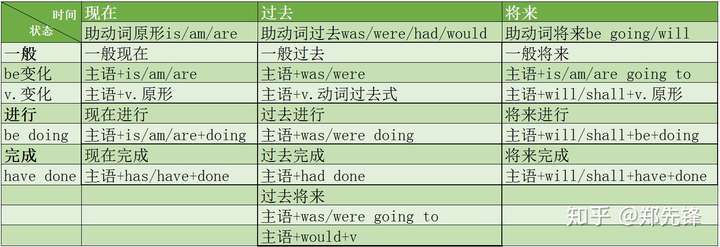 时间:体现在助动词上;状态:体现在实意动词上
时间:体现在助动词上
状态:体现在实意动词上
#现在#
一、一般现在时态(47-51课)
1.结构:
(1)经常的状态:主语+is/am/are
(2)习惯的动作:主语+v(动词)
(3)真理:(1)或(2)的结构
They are very bad.(状态)
They often cheat in the exams.(习惯动作)
The earth is round.(真理的1结构)
The sun rises in the east.(真理的2结构)
2.动词形态变化【主语+v.(动词)】
(1)主语非三单:动词原形
(2)主语三单:动词+s/es
He loves his girlfriend very much.(he三单)
Jim and Lily walk to school every day.(双人是复数,非三单)
They drink beer every night.(they复数,非三单)
My dog watches TV at night.(dog三单)
例子:
He is an IT worker.
They drink beer every night.
He loves his girlfriend very much.
3.一般现在的疑问
有助动词就提前,没有助动词用do提前
先看词性,再看人称(因为2的动词变化,三单也要变does)
Is he an IT worker?
Do they drink beer every night?
Does he love his girlfriend very much?
4.一般现在的否定
有助动词就否定,没有助动词用do否定
He isn’t an IT worker.
They don’t drink beer every night.
He doesn’t love his girlfriend very much?
二、现在进行时态(31-33课)
1.何时用?此时此刻正在做
2.结构
主语+is/am/are+doing
##现在进行时=一般现在时+doing
3.动词(现在分词)
(1)一般+ing
(2)以不发音的e结尾,去e+ing
(3)辅+元+辅(汉堡堡结构)
双写辅音字母+ing,除 opening
live(living)
begin(beginning)
4.现在进行时态的一般疑问句(be提前)
ls/Am/Are+主语+doing?
Are they walking?
No, they are not.
5.现在进行时态的否定句(否定be)
主语+is/am/are+not+doing
They are not walking.
三、现在完成时态(83-85课)
1何时用?
A.截止现在已经完成;
B.表示持续。
2.结构:主语+ has/have+done
3.动词(规则的过去分词和过去式是一样的规律)
(1)一般情况+ ed
call-called
air-aired
(2)以字母e结尾+d
live-ived;love- -loved
(3)以辅音字母+y结尾变y为+ed
try-tried; study–studied
(4)辅+元+辅(汉堡堡结构)将辅音字母双写+ed
stop–stopped
例子:
I have aired the room.我已经给房间通过风了。(已经完成)
He has watched the movie.他已经看完这部电影了。(已经完成)
They have lived in Beijing for ten years.他们住在北京已经10年了。(表示持续)
4.疑问句:have/has提前
Have you aired the room?你已经给房间通过风了吗?
Has he watched the movie?他已经看完这部电影了吗?
Have they lived in Beijing for ten years?他们住在北京10年了吗?
5.否定句:have/has not
You have not aired the room.你没有给房间通过风。
He has not watched the movie.他没有看完这部电影了。
They have not lived in Beijing for ten years.他们没有住北京10年
#过去#
一、一般过去时(67-71课)
#一般现在时的动词变过去#
#没有人称区别#
1.结构:
#一般过去=一般现在的v变过去
(1)过去经常的状态:主语+ was/were
(1)过去习惯的动作:主语+v.(动词过去式)
2.动词变化:略(规则的过去分词和过去式是一样的规律)
例子:
I studied in the US in 2010.我2010年在美国学习。
The bus stopped just now.公车刚刚停下来了。
3.疑问句(一般现在时,动词变过去)
(1)was/were提前(一般现在:is/am/are提前)
(2)Did+动词?(一般现在:do+动词)
4.否定句(一般现在时,动词变过去)
(1)was/were+ not(一般现在:is/am/are not)
(2)did not+动词(一般现在:do not)
二、过去进行时(117课)
1.功能:过去某一时刻、时段正发生的动作
2.结构:主语+was/were doing
#过去进行=一般过去+doing
She was doing her homework at 10:00 last night
They were having a date from 7:00-9:00 yesterday.
3.疑问形式:was/were提前(be提前)
She was doing her homework at 10:00 last night
Was she doing her…?
4.否定形式:was/were+not(否定be)
They were having a date from 7:00-9:00 yesterda
They were not having a date
三、过去完成时(119课)
1.功能:过去某一时刻之前发生的动作、状态(过去的过去)
2.结构:主语+had done
#过去完成=现在完成(have done)have变had
另外:had无人称变化
She had done her homework before 10:00 last night.
The rain had already stopped before 8:00 this morning.
3.疑问形式:had提前
He had left by the time I arrived.
Had he left by the time I arrived?
4.否定形式:had+not
He had not left by the time I arrived.
#将来#
一、一般将来时态(37、91课)
1.基本结构
#1#一般将来=一般现在+going to
#2#一般将来=一般现在变形,主语+will+be
结构1:后面+动词
主语+is/am/are going to(客观、马上、预先计划)
主语+will/shall+v(推荐用will,shall比较少用)
结构2:后面+be+非动词
主语+is/am/are going to+ be+动词
主语+will+be+非动词
例子:
You will be late.你会迟到的
The speaker will be our old friend, John.演讲者将是我们的老朋友约翰。
It’s going to be fine tomorrow.明天天气晴好。
2.疑问句:will/is/am/are提前(will/be提前)
He will come on time.====》Will he come on time?
The woman is going to talk to you.====》Is the woman going to talk to you?
He will show his true colors someday.====》Will he show his true colors someday?
3.否定句:will/is/am/are+not(will/be+not)
You will be late.====》You will not be late.
The woman is going to talk to you.====》The woman is not going to talk to you.
二、将来进行时:(-课)
略(将来补上)
三、过去将来时:(很少单独用,通常在从句用)(135课)
结构:
主语+ was/were going to
主语+ would+v
He was 20 years old at that time. In three years,he would be 23 years old
那年他20岁了,三年后他是23岁。
He told me he would come to Beijing.他昨天告诉我他会来北京的。
Lesson137~138
1.live(长期住)/stay(短期住)
We will travel round the world and stay at the best hotels
stay at the best hotels:住最好的酒店(短暂居住)
I live in Beijing.(长期居住)
2.条件状语从句(1)(真实条件,虚拟语气在第二册才学)
(1)状语:修饰动词
He goes.
He goes there(地点状语)
He goes there by bike(方式状语)
He goes there to meet her(目的状语)
He goes there more frequently(比较状语)
He goes there every weekend(时间状语)
He goes there because it’s late(原因状语,从句)
He will go there if you invite him(条件状语,从句)
(2)条件状语从句:句子作条件状语。
真实条件句:If(一般现在)+I will(将来时/情态助动词)…(如果…就)
if从句中的现在时表示需具备的条件,主句中的shall/will将来时表示可能的结果。
如果我们认为将来的事件是可能发生的,去描述将会发生什么事或不会发生什么事。
If you fail in the exam, you will let him down.如果你考试不及格,你会让他失望的。
If you are too tired, we’ll not go out for a walk.如果你太累,我们就不去散步了。
If you can go with him, he’ll be very happy.如果你能陪他去,他会无比开心的。
If it doesn’t rain tomorrow, we’ll get start.如果明天不下雨,我们就出发。
If he has enough time tomorrow, he’ll come to see you.如果明天有时间,他就来看你。
If you promise to keep a secret, I’ll tell you the truth.如果你能保守秘密,我就告诉你真相
He will help you, if you ask him.如果你请他帮忙,他会帮你的。
I will travel round the world if I have a lot of money.如果我有很多钱我就去环游世界。
I will do nothing if it rains tomorrow.如果明天下雨的话,我就什么都不做
If you want something said, ask a man.
If you want something done, ask a woman.
If it rains tomorrow, we won’t go to the seaside.如果明天下雨,我们就不去海边。
If he falls ,he’ll hurt himself.如果他摔倒了,他会伤着自己的。
If you don’t hurry ,we’ll miss the train.你要是不赶紧点儿,我们就会误了火车
If you feel better, you can get up.你要是感觉好些了的话,你就能起床了
If I am better tomorrow, I will get up.如果我明天感觉好些了,我就起床下地。
If I have a headache, I will take an aspirin.我要是头疼的话就会服用一片阿司匹林。
If I can afford it, I will buy it.要是我买得起的话我就会买它。
What will you do if you win a lot of money?如果你赢了许多钱,你打算做什么呢?
The football match will be put off if rains next week.
Difficulties are nothing if we are not afraid of them.
Be careful, if you don’t want to make mistakes.
3.buy sb sth==buy sth to sb==buy sth for sb,给某人买某物
My husband buy me a gift.我丈夫戴夫给我买了一件礼物。
I buy a book to you.我买了一本书给你。(I buy you a book.)
I have to buy a birthday present for my grandmother.我得给我的奶奶买一份生日礼物
4.then到那时(指将来)
What will we do then?那时我们怎么办呢?
5.课后练习(条件状语从句)
B
1 If he misses the bus, he’ll take a taxi.
2 If he doesn’t sell his old car, he won’t buy a new one.
3 If they offer me more money, I’ll work less.
4 If she doesn’t type the letter, he’ll type it himself.
5 If they come home early, the children will play in the garden.
6 If I am ill tomorrow, I won’t go to work.
7 If I go to the party, I’ll enjoy myself.
8 If he asks me, I’ll tell him the truth.
9 If it rains tomorrow, they’ll stay at home.
C
1 She can live abroad if she is rich.
2 He can travel round the world if he is rich.
3 He can buy a new house if he is rich.
4 They can have a long holiday if they are rich.
5 I can enjoy myself if I am rich.
6 You can offer your boss a job if you are rich.
7 He can fly to Tokyo if he is rich.
8 She can work less if she is rich.
Lesson139~140
1.extra:adj.额外的
extra work 额外的工作
do some extra work 加班
I have to do some extra work today.
extra class课外班
The boy has a lot of extra classes
2.电话用语
(1)呼出
你是Lucy吗?
Are you Lucy?(面对面)
Is that Lucy?/ Is that you, Lucy?(电话)
(2)回答
我是 Venus.
I’m Venus.(面对面)
This is Venus. It’s Venus(电话)
(3)正常通话
Is that you,…?
Yes, speaking.是的,请讲。
3.有关时间的结构
(1)be late for+n名词:(迟到了)
He is late for class.上课迟到了。
They were late for meeting yesterday他们昨天开会迟到了
(2)It’s time for+n名词:(到了做某事的时间了)
It’s time for school.是时候上学了
It’s time for tea.是时候喝茶了
It’s time for dinner是时候吃晚饭了
4.by the way, 顺便(问、说一下)。
说话者忽然想到另一件事的时候用此来表示改变话题。
5.宾语从句,疑问句的语序问题(99、135课)
(1)复习
#1什么是宾语从句:句子作宾语。
#2宾语从句的时态
A.主句一般现在,从句任意时态
B.主句一般过去,从句相应过去
(2)构成1:及物动词+if+一般疑问句(陈述语序)
A.他是医生吗? Is he a doctor?
我想知道他是医生吗?I want to know if he is a doctor.
B.他们以前在北京吗? Were they in Beijing?(were,有构成过去时态)
我想知道他们以前在北京吗?I want to know if they were in Beiing.
C.他打算去吗? Will he go there?(will,有构成将来时态,不可省略)
我想知道他打算去吗?I want to know if he will go there.
D.你看过这部电影吗? Have you watched the movie(have,现在完成时)
我想知道你看过这部电影没?I want to know if you have watched the movie.
E.你喜欢红色吗? Do you like red?(do有动词代替,改动过程可以去掉)
我想知道你喜欢红色吗?I want to know if you like red.
F.他昨天去上海了吗? Did he go to SH yesterday?(did有动词代替,改动过程可以去掉)
我想知道他昨天去上海了没。I want to know if he went to SH
G.玛丽需要帮忙吗?Does Mary need any help?
我老婆想知道玛丽是否需要帮忙。My wife wants to know if Mary needs any help
(3)构成2:及物动词+引导词+特殊疑问句(陈述语序)
A.他是谁? Who is he?
我想知道他是谁?I want to know who he is.
B.你昨天在哪? Where were you yesterda?
我想知道你昨天在哪?I want to know where you were yesterday
C.他什么时候回来? When will he come back?
我想知道他什么时候回来?I want to know when he will come back
D.你读过什么书? What books have you read?
我想知道你读过什么书?I want to know what books you have read.
E.他喜欢哪辆车? Which car does he like?(do有动词like代替,可以拿走)
我想知道他喜欢哪辆车?I want to know which car he likes?
F.你喜欢什么礼物? What present do you like?(do有动词like代替,可以拿走)
我想知道你喜欢什么礼物?I want to know what present you like?
G.你在说什么?What are you talking about?
我不知道你在说什么。I don’t know what you are talking about
(4)引导词:
A.类型
that+陈述句
if+一般疑问句(陈述句序)
what、when、where、which、who+特殊疑问句(陈述句序)
B.省略
在口语中可以省略的引导词:that、which、whom
不能省略:when, where, what, why, how、if、whether
(5)例句
She wants to know when you’ll have a bath.她想知道你何时洗澡。
I don’t know where she lives.我不知道她住在哪儿。
He wants to know what you are cooking.他想知道你在做什么饭。
She wants to know why Mary is late.她想知道玛丽为何迟到。
He wants to know if you are tired.他想知道你是否累了。
Tell Mary we’ll be late for dinner this evening. 你告诉玛丽,今晚吃饭我们将晚到一会儿
6.练习答案
A
1 Yes, Graham Turner is speaking to John Smith.
2 Mary invited Mr. and Mrs. Turner to dinner.
3 Graham Turner said he would be there at six o’clock.
4 Because his boss wanted him to do some extra work.
5 No, he doesn’t.
6 Mr. Turner’s wife wants to know if Mary needs any help.
B
1 I want to know if you are late. Tell me if you are late.
I want to know why you are late. Tell me why you are late.
2 I want to know if you are dirty. Tell my if you are dirty.
I want to know why you are dirty. Tell me why you are dirty.
3 I want to know if you are lazy. Tell me if you are lazy.
I want to know why you are lazy. Tell me why you are lazy.
4 I want to know if you are busy. Tell me if you are busy.
I want to know why you are busy. Tell me why you are busy.
C
1 I want to know if you are writing. Tell me if you are writing.
I want to know what you are writing. Tell me what you are writing.
2 I want to know if you are cooking. Tell me if you are cooking.
I want to know what you are cooking. Tell me what you are cooking.
3 I want to know if you are painting. Tell me if you are painting.
I want to know what you are painting. Tell me what you are painting.
4 I want to know if you are playing. Tell me if you are playing.
I want to know what you are playing. Tell me what you are playing.
D
1 I want to know if Tom got up early. Tell me if Tom got up early.
I want to know when Tom got up. Tell me when Tom got up.
2 I want to know if Tom arrived late. Tell me if Tom arrived late.
I want to know when Tom arrived. Tell me when Tom arrived.
3 I want to know if Tom did his homework yesterday. Tell me if Tom did his homework yesterday.
I want to know when Tom did his homework yesterday. Tell me when Tom did his homework yesterday.
7.宾语从句常用口语
I don’t know what you are talking about.我不知你在说什么
I want to know what you are talking about.我想知道你在说什么
I forget what I had for breakfast this morning.我忘记早饭吃了什么。
Lesson141~142
1.形容词ed后缀和ing后缀的不同(还有很多词语这样)
ed原意/ing令人+原意
excited;exciting(兴奋的;令人兴奋的)
interested; interesting(感兴趣的;令人感兴趣的)
moved; moving(感动的;令人感动的)
surprised; surprising(惊讶的;令人惊讶的)
例句:
He is excited.他很激动
It was surprising.让人惊讶
a moving moment一个令人感动的瞬间
This movie is moving.这部电影真让人感动啊
She is surprised.她感到特别惊讶
This man is interesting!这个人真有趣!
His report on the space exploration was really exciting.他的太空开发报告真令人激动
I can judge that he is very excited from the exciting look on his face.
2.上车
get on:登上
get in:上车
3.复合形容词
各词用连字符连在一起,构成一个复合形容词。(复合词中不用复数)
my four-year-old daughter 我那4岁的女儿(four-year-old 是名词 daughter的定语)
My daughter is four years old.(做表语不用连字符,因为不做形容词)
a thirteen-year-old girl 一个13岁的姑娘
a middle-aged lady 一位中年女士(由名词+过去分词构成)
hand-made 手工制作的(由名词+过去分词构成)
elderly people老年的(这个不是复合形容词)
4. opposite:prep.(介词)在…的对面(方位)
He is sitting opposite me.他坐在我对面
这是介词短语,作状语,表示sit的具体情况
5.curiously:好奇地
curious:好奇的
be curious about:对…感到好奇
The boy was curious about everything he saw.
6.定语后置(定语:修饰名词/代词特征)
..asked questions about everything she saw
她所见到的一切:everything she saw(修饰“一切”)
他所做的一切:everything he did
他所说的事情:something he said
他所留下的一切:everything he left
7.to…表示目的
To make myself beautiful为了把自己打扮的漂亮。
I am coming to see you.
I learn English to go abroad.
He did that to make her happy.
8.被动语态(1)
被动语态的构成: be +done过去分词
时态通过be的变化来体现,被动用done来体现
be:is、am、are、was、were、been(完成时)、being(进行时)
在主动句中,动词的主语是执行动作的人或物。
在被动句中,主语是动作的承受者。
被动语态可以避免用不明确的词作主语,
或是将说话的重点放在事件而不是造成该事件的人或物上。
如果想避免用含混不清的词(如 someone等)作主语,常常可使用被动词态。
(1)一般现在时的被动: is/am/are +done过去分词:
The room is aired regularly.这个房间定期通风。
The knives are sharpened regularly.刀定期磨。
The window is closed.窗户被关了。
He is killed.他被杀了。
The watch is broken.手表坏了。
No man is born wise or learned.没有人是生而知之者(表达一个道理,用一般现在)
It is repaired regularly.它定期修理。
They are corrected regularly.它们得到了定期校正。
Mum, can I go to the zoo with Jack?When your homework is done.
Trees and flowers is planted every year to make our city more beautiful.
The Great Wall is known about all over the world.
This seat is taken
The tea is served
(2)一般过去时的被动: was/were +done过去分词:
She was dressed in red.她身穿红色衣服。
The windows were opened this morning.窗户今早是开着的/被打开了。
He was killed last night.他昨晚被杀了。
Her wallet was lost yesterday.她的钱包昨天丢了。
The cars were repaired last week.这几辆车是上周修好的。
Her son was taken to school.她儿子被送到学校去了。
I was invited to his birthday party yesterday.我昨天被邀请去参加了他的生日聚会。
Sally was invited to a children’s party. ……萨莉被邀请去参加一个儿童聚会。
He was met at the station this morning.今早有人在车站接他。
(3)惯用的被动语态
A.被出生be born…(没谁是主动出生的。。。。)
出生bear-bore-born
He was born in 1984.他出生于1984年
B.被受伤be hurt…(正常人不会主动伤害自己,一般都是被伤害)
受伤:hurt-hurt-hurt
I am hurt.我受伤了
C.被穿进be dressed in(亚当夏娃吃了苹果有了羞耻心,随即被迫穿上衣服)
The lady is dressed in a large funny hat.
(4)何时使用被动语态
a.不知道动作的发出者
It is broken.(不知道是谁打破的)
b.强调动作的发出者
He breaks it.(没有什么感情色彩,就陈述句)
It is broken by him.(强调被他打破的)
c.没必要提出动作的发出者
A new building was built.(重要的是建筑被建造起来了,没必要去知道谁建的)
(4)英语中表达感情的动词通常可用于被动式,
amuse、embarrass、worry、surprise、interest、upset
She is embarrassed.她感到尴尬。
They were worried.他们感到担忧。
(5)被动语态的否定/疑问
被动语态的否定句:be+not+done
被动语态的疑问句:be提前
Was a new building built in our school last year?
Did you go to Jack’s birthday party?No, I wasn’t invited.
Was the room cleaned?屋子收拾干净了没?
The letter was not sent out.那封信还没有发出去
9.课文词组
take out 拿出
put away 收拾好,储存备用
10.课后练习
A
1 Sally is four years old.
2 Because Sally had never travelled on a train before.
3 She sat near the window.
4 A middle-aged lady got on the train.
5 The lady was dressed in a blue coat and a large, funny hat.
6 She opened her handbag and took out her powder compact.
Then she began to make up her face.
7 Because she wanted to make herself beautiful.
8 No, she didn’t.
B
1 Someone airs it regularly. It is aired regularly.
2 Someone cleans them regularly. They are cleaned regularly.
3 Someone empties it regularly. It is emptied regularly.
4 Someone sharpens it regularly. It is sharpened regularly.
5 Someone turns them on regularly. They are turned on regularly.
6 Someone waters them regularly. They are watered regularly.
7 Someone repairs it regularly. It is repaired regularly.
8 Someone dusts it regularly. It is dusted regularly.
9 Someone corrects them regularly. They are corrected regularly.
10 Someone shuts it regularly. It is shut regularly.
C
1 Someone watered them. They were watered this morning.
2 Someone repaired it. It was repaired this morning.
3 Someone dusted it. It was dusted this morning.
4 Someone corrected them. They were corrected this morning.
5 Someone shut it. It was shut this morning.
6 Someone bought them. They were bought this morning.
7 Someone swept it. It was swept this morning.
8 Someone took them to school. They were taken to school this morning.
9 Someone met them at the station. They were met at the station this morning.
10 Someone told them. They were told this morning.
Lesson143~144
1.前缀:sur-上、外、超
surround:v包围
surname:姓(最外面/最上面的名字,家族名字)
surcoat:外套(最外面的衣服)
surface:表面
surpass:超过(超出+经过=超过)
be surrounded by:被…环绕
The village is surrounded by many tall trees.这个村庄被很多高大的树木环绕
2. 树林/森林
wood:n树林
forest森林
3.庞大数字
hundred、thousand、million加多少具体数字,都是单数
(1)单数
hundred:n.百
one hundred
two hundred
(2)复数(固定搭配)
of后的名词必然是复数形式
hundreds of…百上千的
thousands of.成干上万的
millions of不计其数的
4.穿过的区别
through:prep.穿过(立体,纵深向)
across穿过(平面,横向)
across the park(人要通过,公园有平面/线段的感觉,人造物有规律嘛)
across the street(人要通过,街道有平面/线段的感觉)
through the forest(人要通过,森林有立体的感觉)
5.放的区别
place:v放(有安排的,需要设计的)
put:放(随意的)
Put in on the table.放桌上吧
I’ll place the table in the middle of the room.我会把桌子放在房间的中间
6.throw:v扔,抛
throw- threw-thrown
(1)throw away sth:扔掉什么东西(没有指向性,只是强调扔)
基本意思是“投、抛、掷、扔、撒”,
指抛出极轻的东西,如网、筛子等,含有直接抛向瞄准的地方的含义。
作此解时,多用作及物动词,主语一般为人,接简单宾语。
You can throw away the old books.你能把这些旧书扔了。
(2)throw sth away:把什么东西扔掉
(侧重于这个东西,扔这个动作就是专门对这个东西的)
基本意思是“投”“掷”“抛”,
指用工具或徒手将物体轻松地、不在意地或无目的地甩出或抛出,所抛出的物品一般较轻。
偶尔也可指前后或上下地扔。
7.count:V.数,点
The baby can count from one to twenty.这个小宝宝能从1数到20
词组:count sb. in:把……算进去
Count me in.算我一个。
Count Sam in.把sam算进去。
8.cover:v.覆盖
be covered with 被覆盖(强调状态)
be covered by 被覆盖(强调动作和动作发起者,被谁覆盖了)
The trees are covered with heavy snow.
The desks are covered with dust. 桌子上布满了灰尘。
The ground was covered with snow. 地上覆盖着雪。
9.among和between的区别
among:prep在,之间(三者或以上)
between,两者之间
Just between you and me.(两个人之间)
Which one do you like best among A,B and C?在A、B、C三个人之中你最喜欢谁?
10.prosecute:V.依法处置
be prosecuted 被依法处置(不+by,因为一般都是执法者,指向很明确就不用+by了)
He is prosecuted.他被依法处置了。
They were prosecuted.他们被依法处置了
11.On Sundays每逢周日
On Sunday在周日
on Sundays 是泛指“在星期天”,而不是指在某个星期天。
12.主语从句(小小的提及了一下,二册才开始学)
What I(主)saw(谓)made(谓)me(宾)very sad(宾补)我所见到的,使我很难过
I saw.句子作主语-主语从句。
引导词:what
例子:
What I heard made me very angry.我所听到的一切使我很愤怒。
What he did made me very happy.他所做的一切使我很开心。
What he studied made him very intelligent.他所学到的一切使他很智慧。
What the little boy did surprised his mother. 那个小男孩所做的一切使他母亲十分惊讶。
What you do makes me happy. 你所做的是我愉快。
13.定语从句(课文)
(1)
Anyone who leaves litter in these woods will be prosecuted!(定从,修饰anyone)
在林里丢垃圾,将会被依法处置。
will be prosecuted 为将来时的被动语态
Anyone who comes to the party is welcome. 该晚会来者不拒。
Anyone who breaks the traffic regulations will be fined. 任何违反交通规则的人都会被罚款。
(2)
I live in a very old town which is surrounded by beautiful woods. (定从,修饰town)
我住在一个由美丽的树林环绕的古老的小镇上。
which 指代 town 。
(3)
I found a sign which said….我发现一个牌子,上面写着
I got a postcard which said….我收到一张明信片,上面写着
14.被动语态(2)
(1)现在完成时的被动
结构:have/has+been+done(为了凑个be给被动,造了个been)
原来的现在完成时:have/has+done
He has been killed.他已经被杀了。
He has been invited twice..他已经被邀请了两次了。
The ground has been covered with heavy snow.地面已经被大雪覆盖了。
The basket has already been emptied. 篮子已经被腾空了。
They have already been invited. 他们已被邀请。
(2)一般将来时的被动
结构:will/shall+be done(满足了v原形,也满足了被动be done的结构)
原来的一般将来时:will/shall+v.原形
He will be killed.他将要被杀了
The housework will be finished by him soon.家务很快就被他做完了。
The building will be built soon.这座大楼马上就要建成了。
The floor will be swept soon. 地不久就会扫的。
The knives will be sharpened soon. 刀不久就会磨的。
15.课文的词组
clean and tidy 整洁的,清洁的
black and blue 青一块紫一块
happy and gay 高高兴兴
heart and soul 全心全意,一心一意
16.课后练习
A
1 The writer lives in a very old town which is surrounded by beautiful woods.
2 Because it is a famous beauty spot.
3 Visitors have been asked to keep the woods clean and tidy.
4 Litter baskets have been placed under the trees.
5 The writer went for a walk in the woods.
6 Yes, he saw a lot of rubbish.
7 He saw a sign among the rubbish.
8 The sign said, ‘Anyone who leaves litter in these woods will be prosecuted.
B
1 Someone has aired it. It has already been aired.
2 Someone has cleaned them. They have already been cleaned.
3 Someone has emptied it. It has already been emptied.
4 Someone has sharpened it. It has already been sharpened.
5 Someone has turned them on. They have already been turned on.
6 Someone has bought them. They have already been bought.
7 Someone has swept it. It has already been swept.
8 Someone has taken them to school. They have already been taken to school.
9 Someone has invited them. They have already been invited.
10 Someone has told them. They have already been told
新概念·1册·笔记7(Lesson121~144)
https://www.fylstudio.online/2021/07/18/新概念·1册·笔记7(Lesson121-144)/